Tuesday, September 2, 2014

How Many Zentners Are Out There?

This past June, Eric Zentner, an 18-year veteran English teacher with a reputation of classroom excellence, sent an open resignation letter to the West Allis / West Milwaukee (WAWM) School District explaining why he was leaving the profession he loved and detailing disreputable practices and untenable conditions in the WAWM school district:
Zentner Letter (reprinted with permission)
He was the one. He was the one who finally said it all, and said it all out loud.  But he was far from alone.
The speed at which his letter spread teacher-to-teacher, across social media and into mainstream media; the slew of corroborating letters from other WAWM staff that followed, the untimely “retirement” of the superintendent of WAWM schools; the emergency listening sessions hosted by the WAWM school board—all evidence that he was far from alone.
Warning: the following comparison is a stretch, a big one, but one I want to make. I do not intend on deifying Zentner here, but a parallel can be drawn with Martin Luther’s 95 theses. With a nail and a list of violations, Luther voiced the corruptions of an institution he loved, a voice which echoed far and wide.
He said it all, and he said it out loud.
luther_wittenberg_1517His ideas quickly traveled through intellectual circles and across Europe, igniting the Protestant Reformation and    changing the course of Christianity. It’s clear by the speed at which his ideas spread that many in church ranks shared his  sentiments, but dared not voice them prior to his declaration. Papal history bears witness to what happens to  dissenters after all. Retribution, ex-communication,  burning at the stake.
Luther’s courageous letter allowed them to speak out without speaking out.
I imagine multitudes of teachers in Eric Zentner’s district and beyond reading his letter, nodding our heads all the while and then forwarding his sentiments as echoes of our own.
Zentner’s letter allowed us all to speak out without speaking out.
So How many Zentners are out there? Copies of his letters converged in three places in my life. An email forward from a West Allis teacher, a Tweeted online editorial, anarticle in the Milwaukee Journal Sentinel. It travelled far and quick because it speaks the silent truth so many educators face but rarely voice for fear of retribution: a building reassignment, a schedule change, a non-renewal.
One can hope that Zentner’s letter, like Luther’s theses, will have some lasting impact. That it will crack open a larger and more authentic debate about education. That it will it inspire a serious conversation about what is truly good for kids, and how to stop  the exodus of talented teachers from the field they love.
One can hope.

Tuesday, August 5, 2014

An Imperfect Cake: Gamificaiton in AP English

IMG_3838
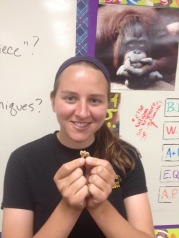
I presented Megan with the first Golden Ape
If you're a Fel 2.0 loyalist, you may recall that in Fall, I committed to gamification in one of my classes as chronicled in my post Monkey Business: The Gamification of AP English.
The notion of gamification appealed to me because of its potential to engage and motivate students, and to somehow make the difficult process of writing an AP Timed essay fun.  Shouldn’t that, after all, be the goal of every educator (and possibly very human being): to make the hard stuff in life fun?
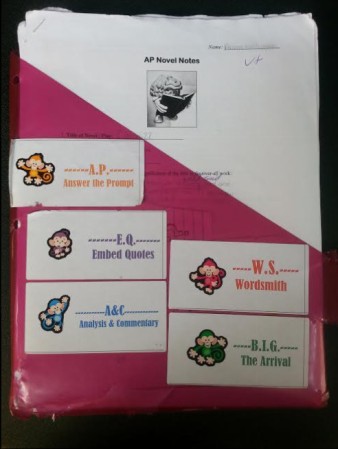
So, I took the toughest part of my Advanced Placement English class and    gamified. Each student competed with him/herself to achieve the requisite AP analytical writing skills (one badge for each skill: focusing  on the prompt, embedding quotes, providing scholarly commentary,  using the vocabulary of literary analysis, and including a substantive  closing) in the hopes that this would land them to a good AP exam score,  and more importantly it would help them master these critical skills for  college and beyond. The golden ape pin (their culminating prize with all 5  badges earned) would be a tangible motivator that would remind them of  their writing ability and the growth they made.
badges
Badge Pride on a Student Binder
 So, what happened? After explaining the gamification process and  badge skills, we dove right in, and  the return of each timed essay found  the room teeming with anticipation. Would they get a badge? If not, why  not? And what would they have to improve in order to get one?
These  simple little stickers were somehow having a profound effect on these  high-achieving students.  This was arguably childish, perhaps even pathetic, but it seemed to be working. They were clearly tuned into their writing at a level I had not previously seen. They proudly displayed their badges on their binders and folders.
Bottom line results?  All of my students received some badges, but only 5 of the 16 received all badges (and the highly-coveted Golden Ape). More on my “take aways” later, but first, theirs:
What They Thought: In an end-of-the-year survey,  All but one student reported that we had “the right amount” of focus on the badges or we should have spent even “more time” on them.


IMG_4157    IMG_4159     IMG_4155    IMG_4160    
Their comments included:
  • “The badges helped my by breaking down each category that I needed to focus on in my papers, and helped me to improve in that way.”
  • “It helped me think about the components of a good essay, especially the Big Ending one. I feel like almost each essay I wrote was stronger than the last.”
  • “Although I didn’t get the golden ape, I found it incredibly useful on focussing myself during essays. It really helped me improve in each of the five important components.”
  • “Not only does it make us think of all of the devices that need to be incorporated, but also adds a challenge and ‘competition’ for us to look forward to.”
  • “I know I worked harder than I would have just for a grade. I really wanted to get that golden APE, and I’m sure any future apes worth their buttons will likewise.’
  • “Having the mini-goals working up to the golden ape was actually very motivating to me and helped me concentrate on all aspects of my papers.”
Not all comments were rainbows and unicorns however, bringing up some critical points for me to consider:
  • “It may have strayed me from the real goal a little bit. I really wanted to get all the badges so I would only focus on doing one thing to get a certain one that week when writing an essay, instead of thinking about having all five components in every one.”
  • “I prefer focusing on well-rounded essays instead of trying to get a specific badge and missing out on the other components.”
  • “It helped me try to incorporate the 5 components, however I think that students should be able to do this without trying to get an award.”
What I thought:
My students were much more motivated to look at specific aspects of their writing and improve them. One of the biggest frustrations in teaching is seeing students make the same mistakes repeatedly without exerting effort to fix them. This was clearly not the case when the process was gamified. Improvement was seen as a logical step in reaching the next level. More students than in any previous year came to conference with me on how they could improve. Students consciously planned what they’d change in their next essay. In this regard, gamification was an unqualified success.
Interestingly, though, when comparing my gamification numbers with the results of the College Board AP English exam, “success” was much more ambiguous. Of the 5 students who received the Golden Ape, demonstrating mastery of each of the timed essay components, 2 of them did not receive a passing score on the College Board AP English exam. Furthermore, none of those who received the top AP English Exam Score of 5 received a Golden Ape in class.
I’ve mulled over these incongruities and I see two different ways to interpret them: 1. My gamification process is not in line with the AP English Exam. I am either measuring the wrong things or evaluating them incorrectly. 2. Those two students who received the Golden APE but did not receive a passing AP exam score either choked on the AP English exam, or their AP Multiple Choice score was so low that even strong essay scores could not bring them up to a passing holistic score.
So my bottom line debrief on year 1: While this experiment clearly succeeded in the areas of student motivation and reflection, there is less clarity in its correlation to AP English exam performance. While I’d prefer that this wasn’t the case (and maybe next year it won’t be) I am comfortable with it.
MistakeBourbonMochaCake-1024x759.jpg
I have always told my students that a passing score on the AP exam  (translating to college credits) is icing on the cake. The true take-away of any class should be learning, self-improvement, and readiness for what the next step in life brings. By that criteria, and from what students said and I observed, I think the gamification process is an imperfect but delicious cake, with or without the icing.  So I’ll tweak the recipe, but continue to serve it.

Friday, July 4, 2014

Follow the Money: ISTE 2014

ISTE graphic

Last year, around this time, I was an International Society for Technology in Education (ISTE) Conference wanna-be, lurking via #ISTE2013, drooling over tweets I was reading by those educators lucky enough to be in San Antonio at the International Society for Technology in Education Convention.
I went so far as to blog all about it last year, dubbing it The Best Conference I Didn’t Attend.
This year, I was fortunate enough to be accepted as a presenter, and so, I spent four glorious days last week at ISTE 2014 in Atlanta, Georgia. Long story short: it is all that it’s cracked up to be. Because of the innovative and immense variety of its sessions, because it’s teeming with “aha moments,” because it means networking with 16,000 like-mindeds, I plan on finding a way to attend every ISTE until the year of my retirement, and perhaps beyond.
Now, instead of recounting all the sordid details of four days of edtech euphoria, I will fixate on one idea: “Follow the Money.” Legend has it that the “Follow the money” phrase was the directive from Deep Throat, the anonymous source that lead to the breaking of the Watergate Scandal and the resignation of a United States President. “Follow the money” suggests that to find the truth of a matter, one need simply follow the money trail.
So, what does this have to do with ISTE 2014? What became readily apparent to me last week is that If one is to follow the money in education, one will quickly surmise that American Corporations, specifically tech-flavored ones, are currently courting American schools like a politician at a donor dinner.
ISTE 2013 conference at the San Angelo Convention Center.
I’ve been to my share of educational conferences and seminars, local, state and national, but in my 20 years of teaching, nothing has come close in scope or sponsorship to what I experienced last week at ISTE.
  • Follow the numbers: 16,000 educators and education leaders
  • Follow the corporations:  500 companies and 4,500 industry reps
  • Follow the prestige: a cut-throat 10% acceptance rate for conference presenters
  • Follow the learning: hundreds of robust, inspirational learning opportunities
  • Follow the VIPs: sponsored networking events galore, top shelf ones requiring VIP badges
  • Follow the Expo Hall: ISTE’s vender hall compared to that of most educational conferences is like Times Square compared to Mayberry Square
  • Follow the Ads: for $13,000 your company can have a prime program ad; $4500 and attendees’ hands will touch your logo as they take the escalator between sessions. Advertising is ubiquitous at ISTE.
Clearly there is money to be made and influence to be gained at the crossroads of technology and education.
Just follow the money.

Monday, June 2, 2014

To Answer Her Question

dialogue1

If you're anything like me, you frequently have the perfect come back…twenty minutes too late.
In this case, was 24 hours too late.
Friday night, my husband and I were at a banquet where we knew no one, so when we noticed a couple searching for a seat, we welcomed them to our table, hoping for some scintillating conversation from strangers.
Conversation inevitably led to “What do you do?” and when she found out I am a teacher,  she asked me what I thought of Governor Walker and all that’s happened in Wisconsin on the educational front these past few years.
“Do you really want to know what I think?” I asked/warned her. “Yes,” she said with sincerity.
I told her budgets are tight, red tape is thick, and morale is low. I told her that I’m not typically one for conspiracy theories, but with the educational legislation being passed (like course choice) it’s hard not to believe that the powers that be are attempting to dismantle public education, to privatize it.
Her response was “And what do you think of that?”
I was  a bit taken aback her question. Was she suggesting privatization would be a good thing? I was about to ask her to clarify when the emcee chimed in and our conversation ended.
And so, now, 24 hours later, I’d like finally to answer her question.
What do I think of privatizing public education?  
  • It’s exclusive. The aim of public education is to benefit all; the aim of privatization is profit for the few. Many charter schools, online academies and for-profit colleges have demonstrated this phenomenon by accruing enormous profits at the expense of their students (high dropout rates and astronomical student debt).
  • It’s elitist. Privatizing education would increase the already existing problem of inequality among schools: the wealthiest areas have greater per student spending and superior resources for their schools. Privatization would exacerbate this problem: the have’s will have the means to attend the best schools and the have-nots will not. Marketplace 101: businesses cater to their wealthiest clientele.
  • It’s dehumanizing. Progressive movements in education strive to individualize the learning experience of each student; for-profit institutions are likely to treat students as widgets and strive to turn out the greatest possible quantity of widgets at the lowest possible cost.
  • It invites corruption. Privatization could result in an increasingly biased and unbalanced curriculum:  Should evolution be taught? the holocaust? human growth and sexuality? religion? All this and more could be decided by the highest bidder, the most influential corporate voice.
  • It’s dangerous to our democracy.  James Madison said “Knowledge will forever govern ignorance; and a people who mean to be their own governors must arm themselves with the power which knowledge gives.” Taking the public out of public education will jeopardize a knowledgeable electorate and the foundation of our democracy.
It’s true that public education needs reform, but privatization is not the answer.
So don’t throw the baby out, just the bathwater.
And that, 24 hours later, is my answer to her question.

Sunday, May 4, 2014

Incredible or Idiotic? Turns Out It's Somewhere In-between.

You may recall dear reader, (or more optimistically, dear readers) back in September, I was embarking on a classroom experiment called the 20% project. Here’s the whole sordid ordeal: “Incredible or Idiotic? You Be the Judge.”

In a nutshell, I was following the progressive corporate model Google and 3M use in allowing employees to spend 20% of their time experimenting with ideas that interest them, resulting in some of their most innovative products. My classroom version had students spending 20% of their time (1 day per week) doing the same: exploring an interest or curiosity. At the end of my initial blogpost, I concluded:
Time will tell...we’ll see if 20% time turns out to be “wasted time” or “an incredible experience.”
 Well, the results are in...and reviews are mixed. Things didn’t go as swimmingly as I’d hoped or they had hoped. In general, and students didn’t achieve as much as they had planned. But beneath it all, some learning (both theirs and mine) did happen.

Their final presentations showed a variety of results: the budding linguists, attempting to create a new language, were not yet finished; the pair who intended to create a documentary on lucid dreaming never really left the research stage; the 365 Club had loads of ideas, but never got the membership it had hoping for. Yet, the equestrian website was live, the cancer patient bracelets were made and distributed, the Sports Drink was developed. A mixed bag of success, kind of like real life.

What was also evident to me that although a central part of the project from the start was embracing the unknown and learning from failure, these accelerated students felt inadequate with anything less than certain success.
Three themes emerged in their reflections:
  1. It’s their fault (public education, that is)
  2. It’s our fault (human nature)
  3. It wasn’t all bad (we did learn something)


1. It’s their fault.

With what seemed to be wisdom beyond their years, a number of students pointed directly at the institution of public education to explain their shortcomings on the 20% project:
“All we have been taught in school is how to fill out worksheets and do specific assignments. We never get independent thinking time which is crucial in the word. In real life, our bosses aren't going to be sitting behind us and being back seat drivers in the workplace.”
And another: “In school, the answers are all in our books, and the questions are all written out.  With this project though, we had none of that.  We had to create our own questions to find answers to and make up our own goals and deadlines.  This style of learning was very hard for me, as well as many other people, because were just not used to it.”
Another student came up with a top 5 list:
“There [are]  5 things public school teach.
  1. Truth comes from authority
  2. Intelligence is the ability to remember and repeat
  3. Accurate memory and repetition are rewarded
  4. Conform: intellectually and socially
  5. Non-conformity is punishable.”
Interestingly, students drew the same conclusion as Sir Ken Robinson in the TED Talk which inspired the 20% project: our educational system simply does not give students enough opportunities for problem solving, creativity and discovery. Therefore, such opportunities are foreign, unfamiliar, and uncomfortable for them.

2. It’s our fault:

Others pointed inward, blaming themselves, and perhaps even human nature.
“The biggest problem I encountered in this project was procrastination.   Although this is a big problem, it is hard to fix because it is just part of human nature.”
Another, said it’s not procrastination, but rather the general harried pace of school to be blamed: “the biggest reason why I didn't achieve as much was because I really didn't have an extra 20% of my time. During the school year, everything is fast paced, set in stone routines. Wake up, get ready, school, home, family, homework, chores, homework, dinner, shower, more homework, and then off to bed; it is life of a 21st century teenager.”
Others said that when it’s “work," it’s joyless. That perhaps anything that’s assigned becomes drudgery: “At first glance, 20% seems like a creative, fun idea, but as time dragged on, being forced to use fun for school sucked the joy right out of what was once fun.”

3. It wasn’t all bad.

Once blame was passed around, students admitted to learning among the “failing”:
“I learned a lot about different syntax. Before I wasn't aware that there was so much diversity in languages.”
“I learned a lot about myself, such as that I get off track fairly easily and I am a huge procrastinator. It helped me kick the problems I had with my behavior a little, which will hopefully help me in the long run for other projects.”
“This shows me that I am self driven and that I don't need to be nagged so that I can complete something by a deadline.”
“I learned from this project that I am a more hands-on type of person, and I don't prefer the textbook and desk style.”
              “I learned that to be more realistic in setting goals, managing time and being more strategic in planning.”
“It's disappointing to think I failed to do what I had imagined, but as a young teenager I can learn from those mistakes. You can use this knowledge throughout your life to take one step at a time, and soon you will be able to look back and see how far you have come. Hopefully, the distance will make you proud.”
So what’s my overall take on all this?

Was it “their fault” (public education?), “our fault” (human nature), or  was it “not all bad” (did they learn?)

Yes, yes, and yes.

One of my more persistent students commented at the end of her reflection: "Perhaps in my future blog posts when the weather starts to warm up. I may be able to report a bit more on this project. Even though the classroom aspect of this is over, I don't plan on giving up.

Me neither.

Monday, April 7, 2014

Ludicrous

I’m generally one to abstain from conspiracy theories. I’m generally one to see the glass half full, I’m generally one to see both sides of an issue, but I’m having a hard time with this one.
Say you’re a kid, 12 years old. Your Dad sends you to the store.
“Go get us four ribeyes, a couple pounds of shrimp, chocolate milk,” he smiles, “and ice cream, any flavor you want.”
This sounds great to you as he just rambled off all of your favorites.
You wait for him to give you the money.
But there’s no money.
You look at him.
He looks at you.
“Go on, you heard me,” he glares, raising his voice “And don’t come back without ‘em!”
You scurry out the door and make your way toward the store without a clue as to what you’ll do when you get there, much less where you’re going to sleep tonight.
Ludicrous? Yes.
Abusive parenting? Without a doubt.
But perfectly analogous to what the Wisconsin State Legislature has done recently to its Public School Districts. State Statute 118.52 (known as Course Options) allows any student enrolled in a Wisconsin public school district to take up to two courses per semester at any other public or charter school or any public or private college while their school district foots the bill.
Sure, it’s a great learning opportunity for students—steak, shrimp, chocolate milk AND their favorite flavor of ice cream—but absolutely unaffordable for local school districts.
Wisconsin legislators are sending districts to the store with no money.
Since Act 10, since public funding of Charter Schools, since Youth Options, Wisconsin legislation has continued to financially devastate local school districts resulting in reduction of teachers, larger class sizes, and decreased programming.
And now, by law, districts will need to pay up to two classes of college tuition ($2902 at UW Milwaukee, $5730 at Marquette, for example) for any student who requests it. Multiply that  by 10 students, 20, 30 or more per semester, and the declaration of bankruptcy by school districts across Wisconsin isn’t far behind.
I’m generally not one for conspiracy theories, but with a mandate that is as ludicrous and wholly unsustainable as Course Options, it’s hard not to believe that there’s an agenda out there, alive and well and powerful, trying to defund and dismantle public education.

Wednesday, February 26, 2014

Facebook, Cheese Whiz, My Husband and other such things

Cheese Whiz? TMZ? Farmville? Justin Bieber? Any shameful indulgences you’re not particularly proud of? Any guilty pleasure you’d like precisely no one else to know about?
Three weeks ago a secret sin of mine was revealed to the greater Facebook community by none other than the man I married. That was the day I quit Facebook.
Those in my world know me as an English teacher, as a reader, a writer, a lover of words. I watch very little television, read whenever possible, and accuse most mass media of numbing the American mind.
Yet there I was that Wednesday night, doing schoolwork on my laptop while Nashville, a nighttime soap opera set in the country music scene, played in the background. It was then that my husband walked in.
This was not the woman he had married.
He stared at me in disbelief and grabbed his iPhone. “I cannot believe what my wife is watching,” he typed and said aloud at the same time. His salacious post inspired much speculation from our Facebook friends. The Kardashians? Barney? Polyamory? Home Shopping Network?
“Stop right now,” I warned him, carefully articulating each word and never losing eye contact.
But he didn’t.
Humorous Facebook comments from others followed, calling me out for my hypocrisy: “This from the queen of high culture?” “Does this mean we can listen to country music during our English department meetings?”  ”GET OUT NOW,” another warned, “first Nashville, next NASCAR, then Monster Trucks.”
I was not as amused as they were. Watching a country soap opera was not a badge I cared to wear. It was a mindless diversion, an escape, a stress ball for the eyes.  It was my guilty pleasure. I neither desired nor appreciated public commentary about it.
What followed was at once immature and life changing.
First, the immature part: My final Facebook post was “I just unfriended Mike Felske.”
I immediately hated that post. For its rudeness, its pettiness, its association in any and every way with me. I then decided I would, at once, return to the practice of using words for meaningful and beautiful purposes, period. And that, for me, meant no more Facebook.
The more I thought about what had just happened, the stranger it seemed.
Strange to unfriend my best friend, unfriend the one person I this world I willingly and enthusiastically agreed to spend my life with.
Strange that social media somehow compelled my soulmate to reveal something to the world that I had expressly asked him not to.
Strange that I would willingly partake in Facebook, that which I now viewed as a vainglorious middle schoolesque platform, often spending 30 minutes or more on it per day.
Strangest of all that I cared about any of this.
So amid all of these strangenesses, I quit.
(That’s the life changing part).  
Three weeks later, here’s my report on being Facebook-free:
  1. I’m more productive: I no longer begin my laptop work sessions with a time-draining cruise down Facebook lane. After a quick email check, I get right to work.
  2. I’m more present: If I’m enjoying an amazing meal, I don’t feel compelled to tell anyone other than the person across the table from me. If my son says something hilarious, I laugh and stay fully in the moment with him instead of documenting it on Facebook.
  3. I’m more observant: I find myself noticing others’ cell phone behavior as deviant and anti-social. Facebook frequenters now strike me as willfully inviting a certain freneticism into their lives. Three weeks ago, that was me. 
You may, dear reader, be asking yourself at this point what any of this has to do with education. This is an educational blog, right? Good point. So here it is: educational relevance.
I’d like to challenge my Facebook-using students and colleagues to ask themselves this question and answer with candor:
Why do you use Facebook?
Is it to avoid your to do list? Is it to gain approval? Is it to exercise your self-righteousness? Is it for self-affirmation? Vanity? Do you feel deflated if a post of yours receives few likes or none? Do you spend 20, 30, 60, 90 minutes or more on Facebook per day? Is the something else more productive or rewarding you could do with that time? Wish you had more time to read, to play with your kids, to exercise? Do you find yourself documenting your life instead of fully experiencing it?  
If you don’t like one or more of your answers, give serious consideration to whether stay or leave the Face Place.
If we, as educators, are trying to model authentic experiences,self empowerment, and a strong work ethic and focus, perhaps we could all stand a reexamination of Facebook’s value (or lack thereof) in our lives.
What is the quality, after all, of our Facebook communications?  What is the quality of our Facebook friendships?  Exactly two (of several hundred FB friends) have contacted me to see if and why I quit (I posted no formal farewell). Only a few more asked my husband of my whereabouts. This suggests what I’d always suspected: most Facebook friendships are superficial: “friends” who are happy to comment if I post, but otherwise I’m off their radar.
At the end of the day, If you don’t document the sushi you’re eating, is it any less delicious? If you don’t post your child’s silver medal in gymnastics, is it a lesser achievement? Are there more authentic ways for us to feel “liked” and connected than a Facebook post?