Thursday, February 21, 2013

Good Dog, Bad Dog


So there I was listening to my superintendent explain district initiatives and priorities: we need individualized student learning; we need meaningful technology integration; we need continual improvement for staff and students.
Dog Biscuits are Not the Answer
I get it. 
I agree. 
He’s singing to the choir.
Until I hear that ominous word: “bonus”
Now I’m sweating.
My pulse is quickening.
My toes are tapping.
But, why?  This is not a new topic in education. It’s happening in other districts; it’s all over education journals. I’ve read about it; I’ve talked about it, and I’ve never had particularly strong feelings about it until this meeting, until it entered into my realm of “the possible.”
Until now, I figured merit pay would be a tricky business, but probably worth exploring at this increasingly complex time in education. It makes sense. Pay teachers according to how well they do. It’s what the business world does, right? Besides, maybe I’d actually be paid for all the extra hours I put in. I should be ecstatic. I should be lobbying the state capital for merit pay.
THAT would be my rational reaction.
But my visceral response at that meeting—my pulse, my sweat glands, my moral compass—told me that the notion of teacher bonuses is at odds with my core values, with who I am as a professional, an educator, a human being.
Why?   
1. It’s insulting. When the word was uttered, I felt violated. After a bit of reflection I figured out why. Embedded within the idea of bonuses is the presumption that I don’t do my best, and that I’d do better for $50 or $200 or $1000. This couldn’t be further from my M.O. I work for purpose, not dollars. I work for students, not checklists.
2. It’s hypocritical. We want students to be life-long learners. We want to foster intrinsically-motivated individuals who want to learn in order to satisfy their natural curiosity, to live richer and more connected lives. We cringe when students ask “Will this be on the test?” before determining if it’s worth their time and effort.
In this vein, many of us (most clearly articulated by Alfie Kohn) feel that our current system is flawed: it conditions students to vie for points instead of learning widely and deeply. We see two extremes in our classrooms: the point-mongers and the disconnected. We yearn to reform this system.
Enter teacher bonuses and merit pay, placing teachers into the same two roles: the point-mongers who grasp at the “to do” list to earn bonuses and the disengaged, (formerly known as highly-effective teachers) demotivated by a system that reduces the art of teaching to a checklist and dollar signs.
3. It won’t work.  Oldest advice in the book: know your audience. The master minds behind merit pay do not know teachers. I don’t know of a single person who went into education for the money. This is self-evident. Contributing. Inspiring. Learning. Making a difference. That’s why people become teachers. Not to make an extra $150 for completing a task or raising a test score.

Students on a conveyor belt. (Pink Floyd’s The Wall, 1982)
4. We are not producing widgets.Whenever the business model is applied to education (which is often the case) we must remind ourselves that we are not producing widgets. We are nurturing human beings in all of their complexity and diversity. When we think back to the most valuable moments in our own education, few of us turn to a fact we memorized, an equation we solved, an essay we wrote. It was a personal conversation we had with a teacher, a mishap turned into a lesson, an inspirational “aha” moment orchestrated by a creative educator.
These moments do not show up on checklists and will not increase by offering bonuses. Their likelihood will decrease as we turn students into data points, as we align widgets on the assembly line, as we strive to meet the criteria on the “bonus" rubric rather than use our wisdom, experience, and creativity to connect with kids and inspire them to grow, question, and learn. 
Maybe we can take a lesson from King Midas: If we wish for a world where everything we touch turns to gold, if we look at teaching as a means to a bonus, if we see our students as dollar signs, we will destroy their humanity and ours.

Tuesday, January 1, 2013

I Wish I Were My Son's Guitar Teacher

I wish I were my son's guitar teacher. 

Not just because that would mean I would be really good at guitar (musicality being something I’m sorely lacking).

Not just because it would be a major ego stroke, knowing that a year and a half ago, my son couldn’t play a note and now he sounds like this.

Not just because I would be teaching him something I know will deeply enrich his learning, his appreciation of beauty, creation, and (dare I suggest) life itself.

The real reason I wish I were my son’s guitar teacher is that it would mean I have arrived as a master educator; it would mean I have achieved what I’ve been trying to achieve in the classroom for 19 years; it might even mean we as educators may be close to bottling the elixir we have been trying to concoct for the past two centuries, namely effective, creative, authentic, self-directed learning.

Allow me to explain.

Backtrack to my son’s first guitar lesson. When Eliot came home that first day, I was a bit surprised he hadn’t learned what a scale was, or the parts of a guitar; instead, he had learned how to play “Smoke on the Water” on one string.  We heard a lot of “Smoke on the Water” that week; it sounded to Eliot and it sounded to us like we had a 9-year-old rock star living in our house. Instead of learning a basic scale, he had been given the belief that he can create music, that he is a musician. That was lesson one.

Performance & recording opportunities are a part of his instruction
Fast forward a year and a half to Christmas Morning this year when Eliot gave me the best gift a mother (who also happens to be a teacher) could receive. In the past, he’d given me a myriad of gifts: painted vases, home-made cards, crocheted bookmarks. I’d always looked forwarded to unwrapping his original creations. This time, though, there was nothing to unwrap.

"Mom, are you ready?” he asked, running into the room with my iPad in hand. I watched as he plugged it into the stereo and started playing my favorite song. Okay, cool, but where’s my present, right? What I quickly discovered was that he had uploaded my favorite dance song into Garage Band, and then added original guitar parts that he’d created, recorded, and remixed into the song.

“So you’re playing the guitar parts?” my husband asked (I was smiling too big to talk). “Well, kind of...there are no
Eliot at play
Eliot at play
guitar parts. I made them up and put them where I thought they’d sound good.” He wasn’t watching me for my reaction (as ordinarily is the case when I open his presents). He was tapping, concentrating, the gears were moving, “I’m a tad off here,” he’d add...or “wait, wait here it is."

The next day, he called me upstairs as he was practicing, and I was taken behind the scenes. He asked me to pick a song. I chose the most over-played song of 2012: “Gangnam Style” (sorry, that’s how I roll). Then, he listened, listened some more, struck a few notes over and over and then a scale, and then, spent the rest of the song improvising over the melody.

He explained to me that Craig (his guitar teacher) taught him to listen to a  song and locate its “root note.” “Play it like the worst bass player in the world,” Eliot quoted Craig, emphasizing the need to test out the root note over and over to make sure it’s right. Then, match it to a major or minor pentatonic scale and “it’ll all sound good cause it’s based on the root note.” It made sense to Eliot, and it made sense to me. “Then, you can have fun with it, adding cool stuff, riffs, frets, bending notes, trilling,” Eliot explained while  demonstrating each.

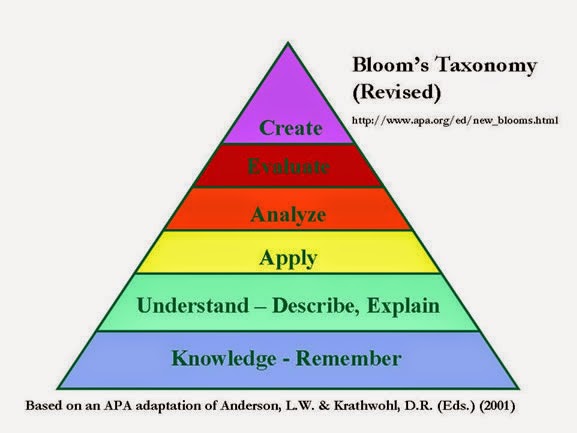
After years of declaring to Eliot that “this is the best present anyone ever made for me” and meaning it each time, this year when I said it, I meant it with an authenticity that transcended my role as a parent and entered that as an educator. What Eliot had done in addition to customizing a Christmas gift he knew I’d love was demonstrate ALL levels of Bloom’s Taxonomy, the gold standard for higher level learning.


He was remembering notes and scales, understanding how they work together to create a melody, but then he was operating at a much higher level: applying a concept his teacher had taught him: analyzing the song, listening for the root note, evaluating which it was and which pentatonic scale should be applied; and then, creating and performing improvisational solo parts.  What’s more, there was no teacher in the room; he had internalized the process, all levels of it, becoming his own teacher in a new situation, with a new song. And then evaluating his own performance afterwards. Basically, an educator’s dream come true.

And right now, as I write this, he’s upstairs doing the same to ACDC’s “T.N.T.” - not my favorite song, not my favorite genre, but his process is music to my ears.  He’s beginning to read the world as music. When we’re eating dinner and he hears a “cool riff” in a song, he runs upstairs to try to replicate it. Clearly the much larger gift here was the one Eliot received from his phenomenal guitar teacher.

And so, aside from my best Christmas gift to date, I'm left with a slew of questions as an educator: How can we do this on a larger scale? How can we get our students to run upstairs (not because of the homework we assigned, but out of sheer excitement) to apply what we've taught them? Is this just a moment in time orchestrated by a gifted teacher with a motivated student in a small group setting, or are there generalizable truths here we can extract and sprinkle into classrooms across the country?

Should the Gates Foundation be visiting Wisconsin Guitar Academy in Mukwonago, Wisconsin? Should Craig Friemoth be giving a TED Talk on the power of improvisational music and learning?

Whatever the case, this gift has me feeling grateful and has me thinking...

Wednesday, December 5, 2012

You'll Be Surprised...


It  was Spring, 1986, my final semester of high school-dom, and the prelude to my first semester as a Marquette Warrior (yes, the pre-Golden Eagle years). Aside from a campus tour, it was my first real time on campus as a student. After spending 90 minutes in a large lecture hall full of other prospective Warriors, writing a scholarship essay for the School of Journalism, I made my first of what would be many trips to the basement of Johnston Hall and had my first wide wif of newsprint in the offices of The Marquette Tribune. 

At that time, you see, I envisioned my future self as a newspaper journalist and I hoped this place would soon enough be my home away from home. It’s where it would all begin.

Later that day, when my oldest sister asked me how it went, I didn’t even remember the scholarship essay I had sweat through earlier. What I told her was how there were 50+ freshmen traversing to Johnston Hall, as anxious as I was to write for the Marquette Tribune, as eager to work their way up to (dared I utter it aloud?) columnist, managing editor, or editor-in-chief.

I had always been an achiever. It was that day that I realized for the first time, I was about to go to college with about 8,000 other students who were similarly success-oriented. The competition (as I viewed it) was fierce. I lamented to my sister over my dismal chances of getting anywhere on the newspaper staff.  

“You’ll be surprised,” she said. “In a year, they’ll be half as many, maybe. The year after that, just a few. If you keep working hard, you’ll be one of them. That’s how it works.”

Perhaps it was the fact that she was my favorite sister (still is), or that as a successful, self-supporting artist, she was living proof of the advice she gave. For whatever reason, I believed her, and sure enough, it turned out to be true: by the end of the year, I’d won an award for investigative journalism; the following year, I was copy editor; the next year, had my own column.

Years later, well into my career as a high school English teacher, her advice proved true once again. When I was pursuing National Board Certification, the final portfolio asked me to reflect on my accomplishments and describe “what’s next.” I remember rolling my eyes at the question,  viewing it as another hoop to jump through for my certification.  Hmmm...what’s next?  I mentioned getting published in a professional journal, presenting at a state conference, writing a book. All three seemed wishful thinking at the time, but within five years, I had accomplished all three. She was right, looking back, I am surprised, but I’m getting less and less so.

Last year, I attended the Midwest Google Summit and was in awe of the presenters - educators who took it upon themselves to achieve a level of mastery with Google Apps for Education which translated into powerful learning experiences for their students. I couldn’t conceive of how they achieved such tech savviness while juggling the demands of a classroom teacher, yet one year later, I’m Google Certified and I just finished presenting at the same conference that left me awe-struck last year.  

Those of you who have made it this far in the post, may be wondering if the point of this post is for me to wax poetic about my accomplishments. It’s actually the opposite. I am still no different than that one among 8,000 back in 1986. I am a foregone conclusion of my sister’s advice.

I still often wonder, “Where do I even begin?” 


Depending on the day, I look at the pile on my desk---insurmountable, unfriendly, and growing---and wonder “Where do I begin?” I look at a classroom full of students: diverse, dynamic, and growing---and think, “Where do I begin?” I look at our country: its divisiveness, its acrimony, its challenges, and wonder “Where do we begin?” It is then that Maryl Streep's line from Adaptation comes to mind: “Just whittle it down.” Focus on one thing and do it. And my sister pops in with an inspiring addendum: "You'll be surprised."
My intent here is to offer some evidence in support of my sister’s 26 year-old advice to her little sister, and perhaps pass it to Marquette Education majors who could use a bit of optimism in what has been a somber couple of years for Wisconsin Educators.
And so here it is (attribution: Alice Klein, favorite sister and unsuspecting life coach as it turns out):  Whittle it down. Persevere. Set your sights high and work doggedly to achieve them; You’ll be surprised. Some say that with growing class sizes, shrinking budgets, and increasing pressures, the field of education should be avoided at all costs. Friends of mine in education have commented on their inability to recommend the field of teaching to those who ask. Some days I agree with them.

But when I take the long view (some might argue the Disney or Rainbow and Unicorn view) I’d still recommend this field to the next generation, my son included. If he tells me someday that he wants to be a teacher, I won’t whitewash the challenges that he will face, but I will tell him that with dogged determination, he will find an interesting niche within a field he will love, he will affect students lives in genuine, lasting ways; and he can do something for a living that constitutes making a positive contribution every day. 

“You’ll be surprised,’ she said,” and I concur.


This blogpost was originally published in The Marquette Educator on Dec. 3, 2012

Monday, October 15, 2012

Giftedness for All

I was a reluctant blogger this time around.

When asked to write a blogpost for 
Wisconsin Gifted Education Week 2012I was intrigued but hesitant.  

The notion of “gifted” has never fully sat well with me.  

In 1972, The National Association for Gifted Children defined “gifted” as students having “high capabilities in areas such as intellectual, creative, artistic, or leadership...and who need services and activities not ordinarily provided by the school to fully develop those capabilities.” 


Hey, wait a minute: is it not my obligation (and pleasure btw) as an educator to work under the presumption that all students have “high capabilities”?


Clearly, there must be something wrong with an educational system that finds itself labeling students with “high capabilities” as “gifted” and finds it necessary to provide “special” programs for them to reach their potential.

Shouldn’t this be a mandate for all students: a covenant that we, as educators, make with every student, every year, so that each student has the chance to realize his/her “high(est) capabilities”?

Perhaps the term “giftedness” itself an indicator of a failed system. Do decreasing budgets and increasing class sizes, state mandates and national directives, curriculum realignment and data-driven decisions (all on top of the social and economic challenges faced by our students outside of school) make it impossible for students to realize their “high capabilities”? Is it this failure which necessitates gifted labels and gifted programs in order that schools can do for some students what it’s failing to do for all students?

So how do I write a blogpost for “giftedness” when I think I’m against it? When I believe that each student has gifts that we must both unwrap and foster. Like the story of Michaelangelo with a slab of marble. He reflected:

In every block of marble I see a statue as plain as though it stood before me, shaped and perfect in attitude and action. I have only to hew away the rough walls that imprison the lovely apparition to reveal it to the other eyes as mine see it.”

Like Michaelangelo seeing the beautiful statue within the block of marble, we must envision each student's "high capabilities” within, waiting to reveal themselves. 

Enter reality: With 45 minute class periods and 150+ students on our roles, how can we offer all of our students challenging, authentic classroom experiences worthy of their high capabilities?

I say by being lazy, annoying, weird, hip and rebellious. It’s what I aim to be.

  • Be Lazy: (not really, actually not at all, but it’s a great attention getter). What I mean is in the classroom, we must make students the active ones, the wonderers, the researchers, the experimenters, the creators while we are the guides, the questioners, the agitators, the co-conspirators. This is how we can reveal their gifts.
  • Be annoying: Answer their questions with more questions. This is annoying initially to students who just want the answers. But we must make them the answer-finders. We can nudge, hint, and guide, but to treat all students as gifted students we have to allow them to struggle, question, analyze, test, and fail. This is how we can respect and grow their gifts.
  • Be weird. Keep them guessing what will happen next. Surprise them, astound them, freak them out. Be the opposite of boring. This will create an atmosphere worthy of divergent thinking and giftedness.
  • Be hip: I’m not suggesting we torch the classics, throw handwriting to the wind, or forget about multiplication because we have cell phones, but I am suggesting that we be part of their world, their technology, their interests, their lives. Not to be the “cool” teacher, but to be the relevant teacher that inspires students to use their gifts.
  • Be rebellious: In a time of increasing emphasis on data points, test scores, and standardized curriculums, we must keep our eyes on the prize. When asked to do things that defy student engagement and authentic learning, we must nod our heads affirmatively and go back to our classrooms and teach in a way that allows all students to recognize their gifts and inspires all students to reach their “highest capabilities.”
Giftedness for all.  

Saturday, October 13, 2012

Happiness and 3 indisputable pieces of evidence thereof


 I was a cynical kid. Evidence?
  • My uncles sarcastically dubbed me "Smiley" as I sat at my Grandma's kitchen table writing my name over and over on many a Sunday afternoon to demonstrate how bored I was. 
  • I thought my Aunt June (arguably the nicest person on earth) was annoying because she was (get this) too nice. 
  • I prided myself on not crying at E.T. The Extra-Terrestrial when all my friends were sobbing as ET left Elliot forever.

As far back as I can remember, I was the family cynic.

And now, I'm writing a blogpost on happiness. "What the Fudge, Fel?" you may ask. Has the cynic in me turned rainbows and unicorns?

It is true: I shall now wax poetic on three reasons for my current happiness:
  1. A victorious moment for a student. 
  2. A vivacious Thank You from a co-worker.
  3. Cake. 

Allow me to explain: 


1. A victorious moment for a student.

One of the lingering "to do's" the last couple weeks has been trying to help a student find a piece of software that might improve his learning experience at school. He has significant dexterity issues which prevent him from writing, and so his accommodation has been typing responses on his laptop. Sounds okay if you don't consider that while everyone else is writing directly on a handout/worksheet/study guide, he faces a blank screen instead of a detailed work space. It's hard for him to later make sense of his answers apart from the context of the original information, and the same goes for his teachers.

One of his teachers (an amazing human being btw who somehow finds time in her inconceivably busy day to care about and follow up on each of her students) came to me for a solution. After exploring what's currently available to him (a monster of a program which is anything but seamless and user friendly) and searching for a viable alternative, I finally found, demoed, purchased, installed and taught PDF Annotator to this enthusiastic young man. 

When we scanned a study guide and uploaded it into this program, he could easily type on it, highlight, and a host of other functions, followed by an effortless export to his document folder and his teacher's email. He was in awe at how easy it was - and I found myself tearing up as I witnessed something I suspect this student had so rarely experienced: something actually helping him learn instead of one more thing getting in the way of his learning. Having a hand in enabling this young man's body to keep pace with his mind, and improve his ability to learn...well, it doesn't get much better than that. That was a privilege.


2. A vivacious Thank You from a co-worker.

So I get this email from a co-worker yesterday telling me that the parents at Parent Teacher conferences were thrilled to know their had made collaborative websites for his class instead of the usual power points. He thanked me profusely for helping him with this unit and teaching web design to his classes and asked if there was an easy way groups could now comment on each others' websites. I stopped down by his room, taught him how to make a list page on his website linking and labeling all the student sites. When I left, he had learned another tech application and I had that crazy fulfilling "I made a difference" feeling once again.


3. Cake.

One of my Geeks made me cake! Seriously!  I believe it's been about ten years since I've had carrot cake (no particular reason - I love carrot cake. I just never make it and for some reason, it rarely finds its way me-ward). So when Adam asked me what my favorite cake was, I found myself saying "carrot." The next thing I realized, there was an "all Geeks text" inquiring whether we like raisins or not, and then: carrot cake appeared during Geek Squad on Thursday. 

Yum!
It was deemed "Fel's late Birthday Cake" (my birthday had been the previous Sunday, and while I didn't announce that fact to the Geeks, it seems Google+ had - Geeks and their technology always get the inside scoops btw). 

And so we ate cake. The Geek Squad continues to be a great source of growth for me, my Geeks and many East Troy Trojans - and so the carrot cake's cream cheese frosting was, well, the icing on the cake. 

Three pieces of indisputable happiness in two days. 

So much for the cynic...

I heart carrot cake.

I heart ET Geek Squad.

I heart technology (even when it's not cooperating).

I heart my job. 

Sunday, September 30, 2012

Which Comes First: The Collaboration or the Desks?


An oval table meant peace was possible in Paris, 1973.
1973. The Paris Peace Accords. The most heated
debate? The biggest stumbling block to an official end to the Vietnam war? Furniture. Before they’d sit down at the table and talk, furniture had to be decided, and it was at a stalemate. North Vietnam wanted a circular table so everyone would be viewed as “equal” with no party at the head. The South Vietnamese wanted rectangular to show the two sides of the conflict. Eventually compromise was reached with a circular table and smaller individual squares around them, and eventually a peace agreement was signed.

Furniture matters.

I overheard a furniture conversation last Spring. Two administrators talking at a conference wondering would happen if they replaced all traditional desks in their district with tables. Would teachers stop lecturing and students start collaborating? Would revolutionary change happen in education?

First, it struck me as a mean-spirited discussion, somewhat smug, and definitely simplistic. As if furniture change could change what fundamentally happens in the classroom. As if all the educational issues on the federal, state, and local levels could simply be solved by chucking the desks and ordering tables.

But then, I realized that I may have inadvertently been a test group of this very theory, having had collaborative desks in my classroom for a year. How had my classroom practices changed with these non-traditional desks? What effect does furniture have on learning? Which comes first: the collaboration or the desks?

Two years ago, I was given the chance to move to a larger classroom and design a space conducive to technology integration and collaboration. Very high on my priority list was ditching the desks: they’re inflexible, they’re not conducive to collaboration, they’re not comfortable (teachers avoid sitting in them during meetings, why do we make students?) So, after much researching, I finally encountered the Boomerang Desk.

My classroom has never been the same:
  • Students expect collaboration: it’s now their default setting, instead of sitting in straight rows, waiting for my instruction.
  • I am clearly not the center of what happens in the room; each group is a center unto itself. Students are the learners, the thinkers, the doers. I am the facilitator, the nudger, the “guide on the side.”
  • Learning is comfortable: students are not crammed into a desk, but have a spacious desktop that can house both their laptop, books, and elbows, if they choose, and a chair that can be closer or farther from the desk, depending on their size and comfort.
  • I can access students more efficiently: when I’m talking to a “quad,” I’m can help a group of four instead of one student at a time.
  • Students help each other. I find myself constantly saying: “Ask your quad,” and they do.
This summer, 8 more classrooms worth of collaborative desks were purchased. I was curious if I’m still the sole lover of the Boomerang desks, so I asked around.

Most comments were similar to my own: “now everyone has their share of the 'pie,'” students are more willing to "share in their small groupings and get immediate feedback,”  "I’m glad to get rid of the old desks, an archaic and ineffective way of furnishing a room.”

A few, though, noted that it’s "tough to fit them all in” during tests when they need to be apart and facing forward. Another said she keeps them ungrouped because she wants all students facing her during class; another said there’s more there’s more chatter when students “should be working.”

And so, reviews are mixed, but my thoughts are these: furniture does matter. Furniture that allows for flexibility in a classroom and encouraged collaboration can support innovative instruction and help create collaborative, critical thinking graduates. Furniture is not the thing, but it’s one thing.

Perhaps there was some truth to what those administrators were pondering. Perhaps a change in furniture can move us forward, can nudge the reluctant into action.  Our classrooms must grow to allow students to move and share and work; our teaching methods must grow to manage student collaboration and provide hands-on activities for learning. Quiet classrooms = quiet brains. If we’re not comfortable with some degree of noise in our classroom, if we’re not comfortable with students not facing us at all times, maybe we need to reexamine what exactly the role of a teacher should be, regardless of what the desks in our rooms look like.

Those at the Paris Peace Accord were concerned who was in charge; they wanted equal standing (don’t our students?) They wanted their voices heard (don’t our students?) they wanted to achieve fairness and peace (don’t we?) and it all started with the right furniture.

Monday, September 3, 2012

In 5 Minutes...

What can you with 5 minutes and a classroom of students?

We have this ritual at our school. A couple days before school starts, incoming Freshmen walk through their schedules, meeting their teachers, figuring out where their classrooms are, getting acclimated to high school. They’re in each classroom just 5 minutes.

So what to do in 5 minutes?

Here’s a window into my teaching soul: I agonize over those 5 minutes, always have. It’s the very first 5 minutes of our relationship. First impressions are made on both sides. They’ll judge me, they’ll judge my class. They’ll decide if this is somewhere they want to be, if this is somewhere where they’ll be challenged, if this is somewhere where they can learn.  

So I faced this question once again this year: How will I spend those 5 minutes?

A bit of background: here are some ways I spent those 5 minutes in recent years:

- I hid under my desk and spoke to the class in a loud British accent via my Shakespeare finger puppet, who inquired about Mrs. Felske’s whereabouts, introduced the class, and finally, ten seconds to go, introduced Mrs. Felske, who popped up and said “Hi,” to an entertained albeit freaked out room of students. Never hurts to be a bit crazy, right? Keeps ‘em guessing.  

- Last year, I got ahold of two iPads and with the assistance of my son recorded a 15 second interview with each student. As a result I knew all of their names (by face) the first day of class, and we had something cool and surprisingly nostalgic to show on the last day of class.

I liked both of those activities; both worked well, but my challenge still remained: how to make those 5 minutes more student-centered: how could they be in the driver’s seat?

My classroom focus this year is full integration of technology: students will each maintain an individual website that will function as their “desk” in my room; they’ll be blogging to the greater world, reading and analyzing rhetoric from Google Reader RSS feeds, using web 2.0 tools demonstrate and expand their language arts skills. I’ve included elements of these in recent years, but this is the year, I’m determined, they will all come together.

So back to the 5 minutes: How to preview this year of tech integration, set the proper tone for learning, get them actively engaged, and get to know them a tad...all in 5 minutes?

After they entered the room, I explained my challenge to them: “How can I have a conversation with 27 individual students in 5 minutes?” One student said “You can’t.” “Ah, but I can, with your help...” And we were off.  Here’s how it went:  

- 30 Seconds: a whirlwind intro to me and my class (message: it’s not about me, it’s about you)
- 1 minute: an explanation of their assignment: Create a 1 minute voice recording, introducing yourself to me: who you are, your background, things you like to do, eat, read, watch, think about. Go to Vocaroo.com, hit record, hit stop, hit share, and email it to me.  (message: We’re about doing in here!)
- 3 minutes: Work and complete assignment (message: We waste no time in here!)
- 30 seconds: save and email assignment: done! (message: You can do this; in fact, you just did!)

There was a flurry of excitement, uncertainty, concentration. Then, the announcement came for them to report to their next class. I looked around: the majority were pressing the send button. I ran around and finished the export with those who weren’t done, and voila, I had 26 recordings in my inbox (one somehow didn’t make it, but will have the chance at a re-do).

What had just happened? Possibly the most economical use of 5 minutes I’d ever experienced in a classroom.

How did it happen?
- The prepared environment: I had spent 10 minutes putting out all the laptops and turning them on, one at each desk, sending the message to students as they entered the room that we’re ready to get to work.
- The right tool: Vocaroo.com is as easy as it gets for voice recording. No login required. No settings to monkey around with. It’s a big clean white screen with a record button. No learning curve. I told the students where the built in microphone was located and they were ready to go.
- Trial run complete: I had tried the recording process myself and finished in 1.5 minutes including hearing the preview. I had a student try it earlier that morning: process complete in 2.5 minutes. This was doable.
- Enthusiasm: “You can do this! Let’s go!” And they did. 


What did I learn listening to their recordings? Here’s a spattering from various students: I have 3 sisters. I’m a very slow reader, be patient with me. I’m a Doctor Who fan. I broke my leg and can’t play soccer. I love Japanese Anime. Shrimp and steak, yum. I LOVE reading. You know my brother; I am not my brother. I’m an official ‘Nerd Fighter’ - (said by several students, leading me to look up the term and smile). I’m going to be a novelist. Are you seriously listening to me? This is fun!  Spaghettios complete me, seriously, if you ever have an extra can... “The Fault in our Stars” by John Green ripped my soul out this summer - you must read it!  You’re going to love me! I don’t like the sound of my voice so this recording is already outside my comfort zone - what’s going to happen in here? Football isn’t just a sport for me, trust me. If you’re patient with me, you’ll end up liking me, most people do. Blue M&M’s, I only eat the blue ones. I predict this is going to be a great class.

Me too.

Five minutes matter. Every minute matters.

Have a great 2012-2013.