If you are unfamiliar with any of the terms above, consider yourself uninformed on important issues in education today, unready for knowledgeable educational discussions, ill-equipped for a job interview in the field of education.
The Solution? The best conference I didn’t attend.
Rather bizarre to write a blogpost about a conference I didn’t attend. But at least I’m better off than I was last year. This time last year, I spent the week pining for ISTE 2012, wishing I were in San Diego with 18,000 other edtech enthusiasts.
This year I spent the week pining for ISTE 2013, wishing I were in San Antonio while kind of being there. Thanks to Twitter, I was able to follow those lucky enough to be there, gathering their thoughts, insights, resources, virtually hanging out in their back pockets.
So what’s the big deal? What is ISTE? The International Society for Technology in Education (ISTE) is a worldwide network of educators engaged in “innovative learning and effective uses of technology in PK-12 and teacher education” (ISTE website). It’s also the creator of NETS—the globally accepted edtech standards for digital age learning, teaching and school leadership.
But the really good stuff? Their outside-the-box, innovative yet practical annual conference which attracting 18,000+ (yes, 18,000) edtech leaders and learners from around the world and offers world-class keynotes, hundreds of sessions in a variety of formats, and a massive exhibit hall. (just take a peek at their sessions).
Next year, with any luck, I’ll be one of the lucky ones in Atlanta, immersing myself in educational technology ideas while tweeting out the wealth with people like the former me, who glean the scraps virtually.
So what can bring you up to speed on the terms listed earlier? What can put you on the cutting edge of educational technologies?
Here are the scraps I was able to hoard this year as a non-participant.
And the very best way to be at “The Best Conference (You) Didn’t Attend”? If you’re unfamiliar with Twitter hashtags, it’s a way to crowdsource resources and ideas collected by those attending ISTE 2013. Typing “ISTE13” into the search bar at the top of Twitter will allow you to read the buzz of ISTE 2013 participants and collect their linked resources and take-aways from the conference, or use the 1-Stop Shop Webilogger to see all 50,000 archived ISTE 2013 Tweets in one full swoop.
Bon Edtech Appetit!
Next year (fingers crossed everyone) maybe I’ll be share with you my first-hand resources from ISTE 2014 in Atlanta, and with even more luck, I’ll see you there!
Ever experience a disconnect between you and what you see in the mirror?
Ever run across an old photo of yourself, and seriously wonderWho IS that?!
I did. Just the other day. But it was a verbal photograph, handed to me by my husband.
He recalled (with great detail) a Claudia six years my younger, who at the time was seriously obsessed with acquiring a cell phone jammer to block her student’s cell phone use in class. She had just returned from scoring AP English essays exams in Louisville, where she had audaciously pledged, along with several of her AP Reader colleagues, to get a cell phone jammer in their classrooms in order to ensure the integrity of their profession.
She spending the better part of a week researching cell phone jammers: how they work, how much they cost, where to get them. (Note her intentional use of the third person, distancing herself from her former self). Though research quickly revealed that cell phone blockers were illegal in the Unites States (still are), that users were prosecuted for theft (of cell phone service) and endangerment (preventing life-pending communication), that fines of $11,000 were issued upon first violation, her determination remained unflapped.
The safety issue, however, did concern her: she’d have to find a blocker that would stay within the confines of her classroom, ensuring administrators and others could receive cell phone reception in the halls outside her room. It would be a tricky endeavor, but after dedicating 14 years of her life to her craft, she could hardly sit by idly while students used their cell phones to text each other answers, photograph her tests, and troll online while they were supposed to be learning.
Her professional integrity was endangered, and so the risk of using an illegal device to save her livelihood was an easy choice. Besides, if she got caught, the righteousness of her mission would be self-evident. Waving to the courthouse camera in a tailored suit with matching sensible heels, she’d become a media darling, representing the very founding principles of public education.
Umm, not quite…and enough third person already.
Long story short: I was never able to find a jammer precise enough to reliably stay within my classroom. And so, the digital age and I had a face off; happily, it won.
Funny now to be reminded of my former self. While nothing else about me has radically changed in the past 6 years, the person hell-bent on installing a cell phone scrambler in her classroom and my current self could not stand in greater opposition.
My current students are encouraged to bring their phones to class. They can zap a QR code upon entry to my room to access my syllabus and today’s agenda. They can backchannel on their phones during class, adding to the class discussion by typing on a group chat without waiting to be called on, they can collaborate on each other’s google docs, collect running data on their progress, engage in research and extension activities—all on the device that I wanted to block.
Perhaps most interesting to me upon visiting my recent former self is realizing that I felt as serious and justified in my jammer acquisition as I do about my BYOD (Bring Your Own Device) policy today.
So why the change? How did I go from cell phone terrorist to BYOB enthusiast?
I think what happened is that I paid attention to the world around me. I go to conferences, I read journals, I discuss and collaborate on listserves and electronic discussion boards. I hear about what’s new, what’s working, what’s effective in the classroom, and I change, modify, and integrate accordingly.
When I started teaching, we didn’t have email or electronic gradebooks; Ten years ago, we didn’t have SMART Boards or smart phones; Five years ago, we didn’t have iPads or netbooks, two years ago, we didn’t have MOOCs, gamification, flipped classrooms and hardly a word was spoken about “Personalized Learning.” Now we have them all, and next year, more likely next month, they’ll be more. And while none of these are the panacea for the challenges faced in education today, none of them mark the fall and decline of education as we know it.
We need to be a part of our students’ world, not apart from our students’ world.
My husband (science teacher) also reminded me that dinosaurs didn’t become extinct because of a great meteor strike, they became extinct because they couldn’t adapt to their changing environment. So while I can laugh now at my anti-cell phone self of yesteryear, I can also be kind of proud to realize that unlike the dinosaurs, I’ve evolved.
One Youtube video + one email + one Facebook post = A Tale of Two Scholars (actually three).
Let me explain.
Suli Breaks, Spoken Word Artist from England, posted a video “Why I Hate School but Love Education” that quickly went viral, nearing the 3 million hits and showing no signs of slowing.
I encountered his video a few days ago when Justin, a high school junior and a former student of mine, emailed to me, explaining: “This describes exactly how I feel about my education.”
The video left me speechless with its heart-heavy indictment of public education. I replied to Justin, coaxing him to explain, which resulted in a lengthy response (“probably the most [I've] ever written,” he reminded me, with a smirk, in the hallway at school).
I then posted the video on my AP English Facebook page with Justin’s tagline: “This is exactly how I feel about my education,” asking my AP English Students (current and former) if they felt the same, which inspired a lengthy Facebook post from Domonic, another former student of mine, currently a college freshman.
Therein lies the genesis of this blogpost: “The Tale of Two Scholars.” Having received their permission to post, I will now get out of the way, posting their full responses and allowing students (the most important, most authentic, and least heard critics of education) to speak:
Justin (High School Junior)
When I was in Waldorf all I wanted was to get out and go to a public high school, but once I started in a public school I hated it and knew that I would be better off in a Waldorf high school. As I look back on my Waldorf education, it was so hands-on and let individuals grow in their own, creative way. In the Waldorf school I was Justin… I was a character… people knew my for who I truly was. In high school I feel more like a number, a letter, a score on a piece of paper that classifies who I am, what classes I can take, and where my future path leads.
School has been nowhere near what it should have been. If you ask me what I learned today I would most likely tell you something that I learned from one of my peers or read online…not something I learned from my teachers. I am so uninterested in what they are teaching because all I focus on is that I need to pass my next test so I get good grades and can go somewhere with my life in the future. And that’s not what I want my future to be based upon. I am more than that test grade I get at the end of the semester. School should challenge you in ways you want to be challenged; it should still teach you a little of everything but in a way that you can relate to and benefit from.
The solution is that the world needs to wake up and realize that we are the next generation, it is up to them to pass on their life lessons. Also much smaller classes with a much more hands on learning environment. They need to teach us that we are individuals, not just numbers or grades. They need to let us be us without trying to influence our ways. They need to teach us to excel to the greatest WE can be not to the class average.
Domonic (College Freshman)
I had a job interview the other day for a summer legal research position. The attorney was telling me about how other attorneys frequently come to him when they’re stuck on a case because he truly believes that there is a way to win every case. For this reason, he told me, he hated specialization and considered it a limitation because someone “may be very good in one area, but if [he’s] in the courtroom with them, [he] will be able to, at some point, out flank them in an area that’s not” their specialty, but still relevant case law.”
I truly believe that all knowledge is power; trivial historical facts may one day help me win a legal case. The Pythagorean Theorem may assist me to…build a garden in my backyard. So to say that students shouldn’t need to learn the details of the Great Compromise or the proper interactions of sine, cosine and tangent, is never something that I’ve personally thought or believed in. Who knows what purpose that knowledge will one day serve in their professional or private lives? But, at the same time, that’s not to say that knowledge that isn’t taught won’t also serve them well. Certainly the educational system can and should improve in areas that are perhaps more relevant to today’s youth, but I don’t believe that should come at the expense of other basic knowledge. And while I acknowledge I am biased, because I never have believed in memorizing things for a test simply to forget them (because I do believe “it” could one day help me).
I truly, truly, truly, truly believe the key to fixing this educational “gap” is so much more complex than just the educational system itself (which could also use some work). Why aren’t American students as inspired…no, as driven to succeed as they once were? Why aren’t they going home at night and studying what they’re passionate about, like students in other countries who are academically surpassing us? Even if it’s just reading Wikipedia pages on history or science or law or engineering or journalism, this is gaining vast amounts of knowledge.
So, three things we need to do:
Get American youth reading again (not tweets, rather books, or even Wikipedia articles if they must)
Re-instill the desire to succeed through their own passion for personal interests outside of school (or in school through EXTRA-CURRICULARS, Problem Based Learning, Independent Study, etc.)
Bring those basic facts that will serve them in God knows what capacity in the future, to the point where they’re not cramming them in, but learning them for life. Use things like increased PBL (FrankenTrial anyone?) (also applicable in #2), a redevelopment of the testing system with broader exams on wider amounts of course material, and real world applications (design your dream home using these geometric principles, defend a high profile supreme court case with precedents from historic cases) with the understanding that it may not help them/us be a graphic artist, electrician, engineer, accountant, etc., but it’ll sure help you be a better one, and a better, more rounded person.
Create the hunger. Feed the hunger. Fuel the hunger.
Final Thoughts:
I hold Justin and Domonic in high regard. Both are good-natured, intelligent, dynamic young men. And while their thoughts about the education they have received from the same community and same school district differ greatly, they represent points on the spectrum of the diverse student body all educators serve. As such we must acknowledge the integrity with which they speak, the voices they represent, the songs they sing, the deficiencies they decry.
For the Sulis, the Justins, the Dominics, we have much work to do.
“Okay,” I thought, “I have a few things to say about this.”
I took the bait, clicked on their link, and after spending 30 minutes on a labyrinth of online questioning, I had the desire to chuck the shackles of the survey and go rogue, putting in my own words my own thoughts on this topic, an open letter to theCAEP, so here it is:
3 Things We Must Admit (and Do) if we’re Serious about Improving Teacher Quality:
1.We have to admit the Intangibles: Measuring the quality of new teachers based on their Teacher Ed program is fraudulent. (See my self-indulgent pie chart above.) Basing this conclusion on no one else but me (in my defense, I’m the most honest case study available to me), I attempted to quantify the factors that constitute who I am as an educator.
In good conscience, I can only track about 5% of my expertise to my Teacher Preparation classes. Another 20% to my formal education in general k-12, B.A. M.A.+. Most of who I am as an educator comes from intangibles: 50% goes to my upbringing, Mom and Dad. It was being raised with high expectations, curiosity, desire to succeed, and an intolerance for mediocrity. I’ll attribute the last 25% to my passion for my subject area (language arts) and my desire to see students succeed. What I realize is that my highly-unscientific self examination undermines the premise of the CAEP Teacher Education Evaluation process. Judging teacher quality based on teacher preparation classes measures 5% of the educator and ignores the other 95%, the all-important intangibles.
2. We have to attract the Intangibles: If you accept my premise that the most important teacher qualities are the intangibles, then our priority becomes clear: to somehow attract those intangibles into the field of education. To get excellent educators, start with the best ingredients.
We need to attract those with a crush on excellence, an unflappable determination to make a difference, a curiosity bent on incessant improvement. In other words, seek and retain top-notch candidates – the ones that are also highly sought by industry and business. And to compete, we need to pay them an attractive salary (college debt forgiveness makes great sense here too). We need to respect educators, giving them the dignity that befits those who are nurturing the next generation. We need to treat teaching as an art that requires years of practice to achieve an ever-changing “mastery.” A high art, a higher calling, a life well spent.
3. We need to nurture the Intangibles. Once we attract the best and brightest, we need to help them evolve into master educators with an authentic apprenticeship program. We need to identify master teachers currently in the field (National Board Certified teachers, for starters), and then leverage their expertise in an intensive mentor role, allowing new teachers to incrementally evolve into their practice over the course of 2-3 sustained years of intense training under the tutelage of a master teacher.
If we were serious about creating a critical mass of master teachers and making serious improvements in teaching and learning, we’d invest in and insist on such a structure.
Admit the intangibles.
Attract the intangibles.
Nurture the intangibles.
These are not easy concepts to quantify, these are not easy steps to take, but the conclusion of this self-indulgent, case-study-of-one teacher/researcher is that acknowledging and nurturing “the intangibles” would be a far more authentic and productive path to sustained teacher improvement than what’s currently being discussed.
And until such steps are taken, aren’t we all kind of fibbing here? Pretending that we can fatten the pig by weighing it?
“The more comfortable you get with where you are, the harder it is to change.”
Those were my husband’s words last Saturday morning as we sat, 30 feet up, on a ski lift, my third week ever as a skier, his third week as my ski coach.
“Why do I have to change now?” I asked, deflated. See, I thought I was in the clear. Over the past two weeks, I had graduated from the bunny hill; I had paid my dues in fits, starts, and falls; I was finally starting to swoosh down the hill with some degree of confidence and control. I figured lesson time was over.
But, he wouldn’t let up: “Point your knee out, little toe edge, keep your torso facing downhill,” he drilled, having me hold my poles out, framing the tree at the bottom of the hill. Torso straight, little toe edge, knee out.
As I added three more details to my brain, the skills I had previously mastered took the backseat and mother nature humbled me, tumbling my body into a white pile of soggy humiliation.
Newbie me, surrounded by my husband and son, ski experts
"Can’t I just stay as good I am?” I asked, now repositioning myself on the ski lift. Impatience and frustration were taking hold as I witnessed what seemed to be the systematic dismantling of my previous progress. My left turns were eroding, my balance was a half-foot behind me. “Why am I changing this now? It’s making me worse,” I lamented.
“Because you can,“ he said knowingly, as we ogled the powder-sugared trees. “The more comfortable you get with where you are, the harder it is to change.” I knew that voice. Sixteen years of marriage makes one an expert at the various voices. This one was the patient, knowing and wise one. As much as I didn’t want to hear it, as much as my body was resisting it, I found myself having the bizarre realization that it not only applied to me, but also to a colleague of mine.
And so, I shall now transition from the ski hill to my place of work and visit an issue that has been causing me anxiety and sleeplessness. I shall place said colleague squarely on the metaphorical ski hill and let my husband evaluate her. “Why do we have to change now?” my colleague asks, dangling her metaphorical skis from the metaphorical chairlift. She has a plethora of protests. We’re interchangeable, she and I: it could be either one of us raising the following objections, she of education, me of skiing. My husband replies to us both:
Us: I can already do this well my way. Hubby: You’ll never ski anything but glorified bunny hills this way. I don’t want you to get comfortable with mediocrity.
Us: I’d rather feel steady and safe than off balance and out of control: Hubby: You don’t know what you don’t know. What feels good and comfortable now will severely limit what you can do later.
Us: I’m happy where I am; Isn’t this good enough? Hubby: Do you want to be Alpine Valley blue hill good, or real-world good? Do you want to be able to ski any condition that comes your way or limit yourself to this, right here?
Us: This is really hard! Hubby: Everything’s hard in the beginning. Everything worth anything, is. But if you want to be better, you’ve got to work through the difficulty.
Us: People will laugh at me Hubby: Actually, they won’t. They don’t. We all fall; that’s how we grow. If you don’t fall down once in awhile, you’re not pushing your limits.
Today's Treacherous Educational Terrain
Tragically, when we disrobe the metaphorical layer, take the skis off the hill and enter the arena of public education, my colleague is not just a single skier stuck in her rudimentary ways. If she’s a teacher, she’s also dulling the competitive edge of her students and her colleagues. And if she’s in an administrator, the impact of her impasse multiplies, crippling other administrators, the teachers she leads, and in turn, their students. She’s an obstructionist.
The terrain is changing dramatically in education, becoming increasingly treacherous, and insistence on using old techniques and old equipment is self-defeating, irrational, and dangerous.
As far as my ski career goes, I plan to fall, to curse, and to grow. And I hope someday to be swooshing down Colorado’s black diamonds, torso straight, little toe edge, shoulders forward, knee out.
To those stuck in beginner mode, I echo my husband’s sage advice: Don’t get comfortable---on the ski slopes, or in the classroom.
So there I was listening to my superintendent explain district initiatives and priorities: we need individualized student learning; we need meaningful technology integration; we need continual improvement for staff and students.
Dog Biscuits are Not the Answer
I get it. I agree. He’s singing to the choir.
Until I hear that ominous word: “bonus”
Now I’m sweating. My pulse is quickening. My toes are tapping.
But, why? This is not a new topic in education. It’s happening in other districts; it’s all over education journals. I’ve read about it; I’ve talked about it, and I’ve never had particularly strong feelings about it until this meeting, until it entered into my realm of “the possible.”
Until now, I figured merit pay would be a tricky business, but probably worth exploring at this increasingly complex time in education. It makes sense. Pay teachers according to how well they do. It’s what the business world does, right? Besides, maybe I’d actually be paid for all the extra hours I put in. I should be ecstatic. I should be lobbying the state capital for merit pay.
THAT would be my rational reaction.
But my visceral response at that meeting—my pulse, my sweat glands, my moral compass—told me that the notion of teacher bonuses is at odds with my core values, with who I am as a professional, an educator, a human being.
Why?
1. It’s insulting.When the word was uttered, I felt violated. After a bit of reflection I figured out why. Embedded within the idea of bonuses is the presumption that I don’t do my best, and that I’d do better for $50 or $200 or $1000. This couldn’t be further from my M.O. I work for purpose, not dollars. I work for students, not checklists.
2. It’s hypocritical.We want students to be life-long learners. We want to foster intrinsically-motivated individuals who want to learn in order to satisfy their natural curiosity, to live richer and more connected lives. We cringe when students ask “Will this be on the test?” before determining if it’s worth their time and effort.
In this vein, many of us (most clearly articulated by Alfie Kohn) feel that our current system is flawed: it conditions students to vie for points instead of learning widely and deeply. We see two extremes in our classrooms: the point-mongers and the disconnected. We yearn to reform this system.
Enter teacher bonuses and merit pay, placing teachers into the same two roles: the point-mongers who grasp at the “to do” list to earn bonuses and the disengaged, (formerly known as highly-effective teachers) demotivated by a system that reduces the art of teaching to a checklist and dollar signs.
3. It won’t work. Oldest advice in the book: know your audience. The master minds behind merit pay do not know teachers. I don’t know of a single person who went into education for the money. This is self-evident. Contributing. Inspiring. Learning. Making a difference. That’s why people become teachers. Not to make an extra $150 for completing a task or raising a test score.
Students on a conveyor belt. (Pink Floyd’s The Wall, 1982)
4. We are not producing widgets.Whenever the business model is applied to education (which is often the case) we must remind ourselves that we are not producing widgets. We are nurturing human beings in all of their complexity and diversity. When we think back to the most valuable moments in our own education, few of us turn to a fact we memorized, an equation we solved, an essay we wrote. It was a personal conversation we had with a teacher, a mishap turned into a lesson, an inspirational “aha” moment orchestrated by a creative educator.
These moments do not show up on checklists and will not increase by offering bonuses. Their likelihood will decrease as we turn students into data points, as we align widgets on the assembly line, as we strive to meet the criteria on the “bonus" rubric rather than use our wisdom, experience, and creativity to connect with kids and inspire them to grow, question, and learn.
Maybe we can take a lesson from King Midas: If we wish for a world where everything we touch turns to gold, if we look at teaching as a means to a bonus, if we see our students as dollar signs, we will destroy their humanity and ours.
Not just because that would mean I would be really good at guitar (musicality being something I’m sorely lacking).
Not just because it would be a major ego stroke, knowing that a year and a half ago, my son couldn’t play a note and now he sounds like this.
Not just because I would be teaching him something I know will deeply enrich his learning, his appreciation of beauty, creation, and (dare I suggest) life itself.
The real reason I wish I were my son’s guitar teacher is that it would mean I have arrived as a master educator; it would mean I have achieved what I’ve been trying to achieve in the classroom for 19 years; it might even mean we as educators may be close to bottling the elixir we have been trying to concoct for the past two centuries, namely effective, creative, authentic, self-directed learning.
Allow me to explain.
Backtrack to my son’s first guitar lesson. When Eliot came home that first day, I was a bit surprised he hadn’t learned what a scale was, or the parts of a guitar; instead, he had learned how to play “Smoke on the Water” on one string. We heard a lot of “Smoke on the Water” that week; it sounded to Eliot and it sounded to us like we had a 9-year-old rock star living in our house. Instead of learning a basic scale, he had been given the belief that he can create music, that he is a musician. That was lesson one.
Performance & recording opportunities are a part of his instruction
Fast forward a year and a half to Christmas Morning this year when Eliot gave me the best gift a mother (who also happens to be a teacher) could receive. In the past, he’d given me a myriad of gifts: painted vases, home-made cards, crocheted bookmarks. I’d always looked forwarded to unwrapping his original creations. This time, though, there was nothing to unwrap.
"Mom, are you ready?” he asked, running into the room with my iPad in hand. I watched as he plugged it into the stereo and started playing my favorite song. Okay, cool, but where’s my present, right? What I quickly discovered was that he had uploaded my favorite dance song into Garage Band, and then added original guitar parts that he’d created, recorded, and remixed into the song.
“So you’re playing the guitar parts?” my husband asked (I was smiling too big to talk). “Well, kind of...there are no
Eliot at play
guitar parts. I made them up and put them where I thought they’d sound good.” He wasn’t watching me for my reaction (as ordinarily is the case when I open his presents). He was tapping, concentrating, the gears were moving, “I’m a tad off here,” he’d add...or “wait, wait here it is."
The next day, he called me upstairs as he was practicing, and I was taken behind the scenes. He asked me to pick a song. I chose the most over-played song of 2012: “Gangnam Style” (sorry, that’s how I roll). Then, he listened, listened some more, struck a few notes over and over and then a scale, and then, spent the rest of the song improvising over the melody.
He explained to me that Craig (his guitar teacher) taught him to listen to a song and locate its “root note.” “Play it like the worst bass player in the world,” Eliot quoted Craig, emphasizing the need to test out the root note over and over to make sure it’s right. Then, match it to a major or minor pentatonic scale and “it’ll all sound good cause it’s based on the root note.” It made sense to Eliot, and it made sense to me. “Then, you can have fun with it, adding cool stuff, riffs, frets, bending notes, trilling,” Eliot explained while demonstrating each.
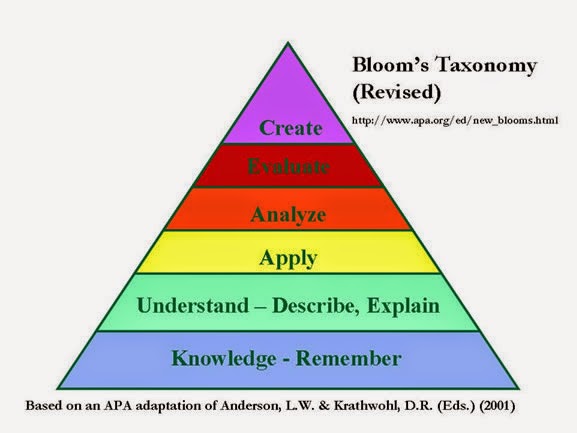
After years of declaring to Eliot that “this is the best present anyone ever made for me” and meaning it each time, this year when I said it, I meant it with an authenticity that transcended my role as a parent and entered that as an educator. What Eliot had done in addition to customizing a Christmas gift he knew I’d love was demonstrate ALL levels of Bloom’s Taxonomy, the gold standard for higher level learning.
He was remembering notes and scales, understanding how they work together to create a melody, but then he was operating at a much higher level: applying a concept his teacher had taught him: analyzing the song, listening for the root note, evaluating which it was and which pentatonic scale should be applied; and then, creating and performing improvisational solo parts. What’s more, there was no teacher in the room; he had internalized the process, all levels of it, becoming his own teacher in a new situation, with a new song. And then evaluating his own performance afterwards. Basically, an educator’s dream come true.
And right now, as I write this, he’s upstairs doing the same to ACDC’s “T.N.T.” - not my favorite song, not my favorite genre, but his process is music to my ears. He’s beginning to read the world as music. When we’re eating dinner and he hears a “cool riff” in a song, he runs upstairs to try to replicate it. Clearly the much larger gift here was the one Eliot received from his phenomenal guitar teacher.
And so, aside from my best Christmas gift to date, I'm left with a slew of questions as an educator: How can we do this on a larger scale? How can we get our students to run upstairs (not because of the homework we assigned, but out of sheer excitement) to apply what we've taught them? Is this just a moment in time orchestrated by a gifted teacher with a motivated student in a small group setting, or are there generalizable truths here we can extract and sprinkle into classrooms across the country?
Should the Gates Foundation be visiting Wisconsin Guitar Academy in Mukwonago, Wisconsin? Should Craig Friemoth be giving a TED Talk on the power of improvisational music and learning?
Whatever the case, this gift has me feeling grateful and has me thinking...