Monday, January 11, 2016

Lessons in a 4-inch Box

You can take the teacher out of the classroom, but you can’t take the classroom out of the teacher. It’s Christmas Vacation as I write this, and I have students-on-the-brain.
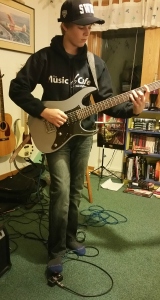
Case in point: I’m watching my son enjoy his favorite Christmas present, and it’s got me thinking about teaching again.
It’s the loop pedal’s fault. I didn’t even know what a loop pedal was until I gave Eliot’s Christmas List its due attention. And now, not only do I think it’s the best present we could have bought him, but I think it’s a master teacher.    

loop
Huh? How can this little contraption (“THIS was $99?” I exclaimed, unimpressed, upon its arrival) be so miraculous?  What, even, is it? The loop pedal is a gadget that allows Eliot to make short recordings with his guitar and then play over those recordings, creating loops or layers of music. And because it’s a pedal, the recording part is “hands-free,” making the process of playing, recording, listening, re-recording and layering seamless.
But is this teacher sacrilege? How can I give an inanimate object teaching kudos, especially since singing the praises of Eliot’s real-life guitar teacher, Craig Friemoth? It was just two Christmases ago, when I wrote about Eliot’s gift to me: he had taken my favorite song at the time and created and played an extended, remixed version of it for me on his guitar. I called it “the best present I’d ever received.” It affected me deeply as a mother and as a teacher as I witnessed Eliot’s growth as a musician and I pondered how to elicit such creativity and engagement in my classroom.
The continuing influence of Craig’s teaching on Eliot’s love of music and growth as a musician can’t be overstated. How, then, can I now bow down to the almighty loop pedal as the ultimate teacher?
Here’s how. This is what he’s doing:
dsfasdfads
Eliot & loop pedal at play
  • He’s examining the process of music making and the parts of a song.
  • He’s perfecting his craft. In any process, there are “cheats” and shortcuts. But a loop recording exposes and amplifies the smallest error. So now there’s an organic motivation for perfection which is fueling extra practice.
  • His creativity has exploded. His love of playing classic rock riffs continues, but now it’s mixed with loads of experimentation.
  • His aha moments are many.  After he plays a loop, adds another and another, I hear all sorts of “ah,” “no” “okay...”wait”... as he’s discovering the interplay of these sounds and then tweaking them for various effects.
  • He’s learning the thickness of music. By that I mean he’s experiencing the richness of music as the sum of its parts by deconstructing it and then reconstructing it. It’s like playing in a band while being all the band members.
  • Perhaps most importantly, he’s getting that all-important feedback loop that we know is critical to learning. The loop pedal doesn’t lie. It plays back what it hears, making him painfully or ecstatically (whichever the case may be) aware of his abilities, providing feedback and motivation for correction.
Make no mistake: without the guidance of Craig, Eliot wouldn't be ready for any of this. A master teacher enables a student to become his own teacher and prepares him for other “teachers” (human and non-human varieties) he’ll meet along the way.  
And so, I end with three pats on the back and a question:
First the back pats:
  1. One to Mike and I for heeding the Christmas list.
  2. One to Eliot for creating it.
  3. One to Craig for making him ready for it.  
And now, for the perpetual question:
How can we as educators do this? How can we provide for our students the foundation for life-long learning, the readiness to recognize and leverage all the potential teachers they will meet in life?  

Sunday, December 6, 2015

Dear Cassidy: A Case for Senior Year

Dear Cassidy*


I must admit, when you told me a few weeks back that you want to graduate a year early to get a jump start on college, an immediate and somewhat surprising sadness washed over me. I tried not to show it, but I think you may have noticed.

I’m also pretty sure that when you asked me for a letter of recommendation this isn’t what you had in mind. Fear not, I wrote two letters: one to the Office of Admissions and another (this one) to you.


In the official letter, I praised your academic achievements, your talents as a thespian, musician and athlete. I also recommended your admission into college, since that was your wish.


And while I stand by every laudatory word I wrote in that letter, it was not my complete recommendation. An unadulterated version would include my recommendation that you stay in high school next year, that you don’t live your life in fast forward, that you experience (dare I suggest treasure) your senior year.


Why? Because the thing about senior year is that there’s only one of them.


My fear is that if you don’t experience senior year, you’ll miss out on one of life’s great experiences, like someone who’s never slurped a shave ice at the beach, never made a snow angel, never read a Harry Potter book, and has to go through life wondering what all the nostalgia is about.  


There’s so much in senior year that’s celebratory, cumulative, and icing-on-the-cake-ish. It’s a chance to celebrate you and the culmination of 13 years from the moment you walked into kindergarten with your velcro shoes and Little Mermaid backpack when telling time and writing your name were your biggest challenges to the moment you walk out of high school in yoga pants and leg warmers (yes, they’re back) able to quote Shakespeare, explain the double helix, and play Take Five on the saxophone. A journey worth completing, a rite of passage worth celebrating.  


Pondering this, I recently recruited the wisdom of Facebook friends, asking their thoughts on senior year and early graduation. Here’s a sampling of their responses:


from recent HS grads:


  • I feel like if I had needed to go to college after junior year I probably could have done it but senior year gave me time to really be ready to move on. I think it would have been a shock to move to a huge campus setting a year earlier than I did.
  • Senior year was my favorite year of high school! I got to take classes that I really enjoyed and these classes gave me skills that I'm currently using in college. Besides academics, I felt that my extra curriculars, like theatre and choir, were the most rewarding during my senior year. I'm incredibly thankful I had all of that time to spend with my favorite people.
  • Being able to graduate and experience those "lasts" of senior year with the people and friends I grew up with from grade school is important, I think. I've always believed that with anything in life the journey is just as important as the destination (as cliche as that might sound), especially when you’re young.


from Adults (friends and colleagues):

  • I think it's indicative of a problem in our culture, no one lives in the moment, they are constantly looking forward to the next thing. No one enjoys the here and now.
  • I really became comfortable in my own skin during my senior year. I stopped caring so much about what other people thought of me. I grew out of that teenage funk and sprouted grownup wings.
  • Senior year is when it all somehow came together for me. Without realizing it, I become a leader and became responsible for myself. And by the end of senior year, I was finally ready to leave it, the perfect confluence of events.
  • Frontal brain development! No matter how mature or intelligent someone seems, that frontal lobe is just not developed. Only time can do that.
  • Hurry up and finish high school so you can hurry up and get through college so you can hurry up and work for the rest of your life?! It's about the journey--not about racing to the finish line. And college is a whole lot more expensive - financial aid and scholarships just aren’t there for early grads.
  • One year at that time in your life is HUGE. I wasn’t ready for the freedom and risks and temptations at college. I probably thought I was, but I wasn’t.


I must also note one of my FB friends who veered from the “pro senior year” camp, wisely pointing out that “not every student has a perfect home life...and moving on is in their best interest.” She also pointed out my central contradiction: that if I didn’t think early graduation was a good idea, perhaps I should consider not writing you a letter of recommendation.  


As your teacher, though, I believe it’s my job to teach you, support you, and prepare you for your next step, whatever that may be. It’s my job to write a letter of recommendation that honestly represents you and conveys your abilities. It’s your job to decide what those next steps are.


So now, two letters are complete: one about you as a student, someone who can, if she chooses, face the rigors of college one year early; and one to you as a person, someone I care about, someone whose ultimate decision I will wholly respect.


Best of luck to you, Cassidy.*


With fondness,
Mrs. Felske


*Name has been changed to protect the scholarly.

Sunday, November 8, 2015

Just for the Record: I Am Not a Prostitute

So I get this email from ETS (of ACT/SAT/AP super-testing fame) offering me the “opportunity” to score STAAR (State of Texas Assessments of Academic Readiness) exams.
And even more exciting than the prospect of electronically scoring standardized tests in the isolation of my own home is the whopping $13 per hour they are willing to pay me.
At this point, equal parts disbelief, insult, and amusement are frolicking in my head.
$13, seriously?
Just for the record, I am not a prostitute, physically, academically, or otherwise.
This has me thinking, why do we do what we do, and why do we do things for money?
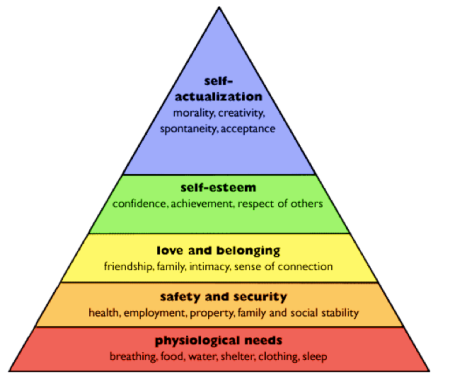
Maslow’s Hierarchy of Needs (thank you Psychology 101) comes to mind.
Maslow
Abraham Maslow’s Hierarchy of Needs
Maslow reminds me that if I have my most basic needs met (food, water, shelter) unless I’m a former Olympic runner from Stevens Point, I will not prostitute myself for money. So ETS loses on that count.
Next comes safety and security, and since I have good health and gainful employment, ETS’s $13 per hour fails to lure me on the physiological front.
Love and belonging? Check and check as I count a loving family and wickedly fun friends among my good fortunes. And besides, one can hardly imagine hours of scoring standardized tests providing love and belonging, but rather their opposites.
Next on the Maslow plate is self esteem. You know, confidence, achievement, respect from others? The things that scoring standardized tests would suck from the marrow of my very bones.
Finally, self actualization, the highest level of Maslow’s hierarchy. This is nirvana, flow, purity of soul and spirit, notions known to vaporize in the mere presence of standardized tests.  
So, ETS’s job offer pretty much fails on all levels of human needs and desires, leaving one to ask what conscientious and competent educator in their right mind would score standardized tests for $13 per hour?
None, I think, and here’s why:
  1. Teachers are busy, very busy. Show me a teacher who doesn’t do school work at night and on weekends, and I will, with great disbelief, ask you to prove it.
  2. Teachers who love being teachers love the kids, love the content, love the teaching itself, but rue the stacks of papers and tests. Correcting is the bane not the allure of the profession.
  3. Teachers are human beings. In the little down time we have, grabbing a book, touching base with our spouses, getting to know our own kids, taking a lap at the gym—these are things we aspire to do, not assessing standardized tests.standardized-testing-comic3
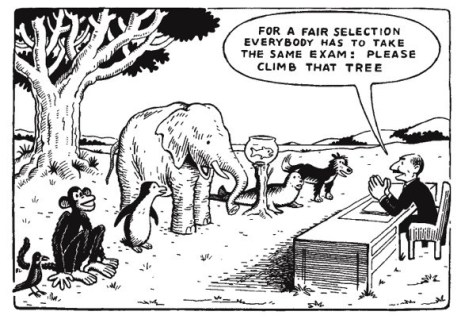
  4. Standardized tests (as I’ve written repeatedly) only work on standardized kids. Our students are dynamic individuals who develop at different rates and have different aptitudes and abilities. This is why we need to teach them as individuals and not judge them in a standardized, meaningless way.
  5. Finally, $13 per hour is inordinately insulting. If standardized tests are to be given, they must be scored in a valid, reliable manner by qualified experienced educators. $13 per hour is in no way commensurate with the task, and will in no way attract qualified experienced educators. You   get what you pay for, and while ETS will find people to score the STAAR exams, they will be inexperienced unqualified non-educators who determine the outcomes of these high-stakes exams which have enormous consequences for students and schools.  And that, ETS, is simply disgraceful.  
So, for all the reasons mentioned above, to borrow the timeless lyric of Johnny Paycheck, “Take this job [ETS] and shove it.”
And remember, just for the record, I am not a prostitute. 

Sunday, October 11, 2015

The Frogs are Boiling

Something inhumane and downright repulsive is happening in school districts across the country. Frogs are slowly being boiled to death, en masse. And once more, no one seems to be noticing, least of all the frogs.
You may have heard the story that if you put a frog into a boiling pot of water, it will leap out to escape certain death. But if you put a frog intofrog a kettle at room temperature, and gradually heat the water to boiling, the frog will stay for the duration, facing death without so much as a splash.
This is what’s happening in education today: the slow and systematic boiling of frogs.
Case in point: my school district.
This past spring, I heard a devastating piece of news---Forensics, an extracurricular speech and performance program---was on the chopping block. I expected (or at least hoped) for some vocal opposition, but there was nothing, no letters to the editor, no outraged parents, students, or coaches at school board meetings. Not a croak of a frog or a chirp of a cricket to be heard.  And so, the Forensics program quietly disappeared.  
Since I’m no longer a Forensics coach (I resigned when I realized that teaching, coaching, and parenting would render me inept at all three) I cannot make a direct plea for the reinstatement of my Forensics program, but I can go on record about what Forensics and extra curriculars in general mean to students.
My dozen plus years in Forensics as a coach, judge, and participant were defining moments in my life, taking me from a quivery-voiced freshman to a confident orator when I was in high school, and allowing me a deep connection with my students as I coached them through similar experiences.  
When we weren’t dispelling the misconceptions about Forensics (no, it does not involve dissecting cadavers) we were reciting, orating, storytelling, demonstrating, impromptu speaking, broadcasting, and acting. (Fun fact: "Forensics" is a tradition rooted in Ancient Greek speaking competitions, a skill they deemed central to democracy).
In Forensics, aside from collecting state medals and power round trophies, students gain confidence as speakers, develop their voices, ideas, and identities in authentic ways, no longer needing to rely on the “imagine your audience in their underwear” mantra in order to survive and thrive in public speaking situations.  
And, as is the case in so many extracurriculars, far more important than the tangible take aways are the incidental ones. I suspect many on my Forensics team will remember the following phenomena as much if not more than their trophy-winning performances:
  • the lengthy “thank you” speeches by every team member on the bus ride home
  • the “Golden Pizza Award” given for the most slices consumed at the Pizza Hut buffet
  • Kevin reciting all the US Presidents and their birthdays by memory at each meet
  • The Least-Need-for-Caffeine Award (Gwen!)
  • Andrea, our probing videographer, collecting sordid interviews and season highlights
  • Emily floating down the halls at meets, flapping her “wings” like a butterfly
  • Kopp’s meets (“no cheeseburgers!”)
  • Fel and Scott dancing the tango across the awards stage
  • the improbably coupling of Henry and Leah
  • Jason’s infamous “Capitalism, Sweet Capitalism” speech
  • Jesse, Ian & Brett as the typing monkeys
  • Our Austin Powers themed home meet
and so many more...
Together, we were supportive, hilarious, melodramatic, ridiculous, inappropriate, serious, proud, accomplished, protective, defeated, victorious, nervous, ecstatic, goofy. Priceless stuff in the life of a teenager.
And such moments, while specific to our team, will feel familiar to anyone who has been involved in an extra-curricular activity. While teams provide a constructive use of time and a structured opportunity to improve skills, perhaps more importantly, they provide a sense of belonging and confidence and happiness that many students don’t necessarily find elsewhere.
Studies confirm that extra curriculars increase student self-esteem, collaboration, positive relationships, and positive feelings about school; they decrease unexcused absences, academic failure, and bullying behaviors. Research shows that 68% of students who participate in extracurriculars are likely to earn a Bachelor’s degree or higher compared to 48% of those who don’t.
What we also know is that our student body is diverse. Not everyone is interested in football or soccer or FBLA, or Science Club, or Forensics, or Band, but the hope is that the more diverse our offerings are, the more likely it is that each student can find one activity which interests him/her, one way to connect with peers, build confidence, and develop a sense of belonging at school; and if they do, the relatively small cost of extra curriculars more than pays for itself in the long-term social-emotional well being of that student and in the civic and socio-economic well being of our larger society.
save the frogsMy fear is that we are so accustomed to cuts and losses in education these days that, like the frog in the kettle, we have become desensitized the imminent danger that lies ahead. Cutting one more program is akin to cranking the temperature up five more degrees on the stove, all too easy to slip by unnoticed while the frog slowly dies on our watch.  
I think about what I would have missed out on without having Forensics. I think of Stacey, Tiffany, the Gwens, Scott, Karen, Alan, Andrea, Jason, Anna, Ian, Laura, Jesse, Brett, Kristin, Jackie, Katrina, Josie, Henry, Alicia, Jillian, Tara, Margaret, Cheri, Brian, Molly, Jenni, Joe, Vicki, Leah, Alicia, Kevin, and so many others.
If we don't speak up, we're all complicit in the death of this frog. 
Save our Frogs.  
Save our Kids.


Monday, September 14, 2015

There Are No Rules and All the Rules Have Changed

A great man once said (actually it was Tom Brokaw last week on Meet the Press): “There are no rules and all the rules have changed.” He was talking about the trumpification of politics, but he might as well been talking about the state of education since it’s become clear that all the rules in education have indeed changed.
Incidentally, the alternative title for this blogpost was “I Just Lost my Two Best Friends.” The two titles are, in essence, one: I lost my two best friends because all the rules have changed.
We three began our teaching careers together, same year, same high school. The year was 1993---she, the beautiful new French teacher, he the handsome guy smiley of the math department, and me somewhere in between. Over the next 22 years, we became best friends, our social lives and families deeply intertwined. Naturally, I assumed we'd also share a retirement banquet decades later.  
Now, somehow that dynamic French teacher and that gifted math teacher are no longer in the classrooms down the hall, no longer at my lunch table, no longer in the faculty lot when I arrive in the morning or leave after school. And I'm heartbroken, as are many of their students. It just doesn't feel right. It feels like someone broke the rules because there were rules after all, unwritten as they were.
Broken Rule #1: Loyalty is a two-way street.  Our school district was good to us; and in turn, we were
good to our school district. Teaching in a small rural school, we were immune to many problems faced by larger districts. We knew this, and we were grateful for it. We educated generations of students, and we knew our students, our curriculum, and our community inside and out. This was a win for our students, our district, and for us. We could also rely on predictable pay scales with a clear path to increased salaries over the long haul. For all of these reasons, we stayed put. Whenever someone left, it was for one of three reasons: retirement, a serious health issue, or a change of vocation altogether. Teachers didn’t leave in order to teach somewhere else. They just didn't. We were “Lifers,” and many town residents had the same teachers as their parents: classroom stories were passed down generation to generation like sacred folklore. 
Compare that with our current reality: three of our teachers recently left to teach at other high schools, two left within two weeks of the new school year.  And this is hardly an anomaly; it’s happening on a much larger scale in districts across the state.  Act 10 and decreased state funding (the “tools” Governor Walker gave localities) have forced many districts to freeze or decrease their payscales. This has led many teachers, with mortgages and college tuitions looming, to surf the job market. Talk to any superintendent or principal in Wisconsin and you'll hear the same story: I spoke recently with a principal who'd lost 14% of his staff the month before school started. Imagine the long term consequences here: wealthy districts landing the most qualified teachers and poor districts, the least. The gentrification of teaching. Hardly the ingredients of free and equitable public education.  
Broken Rule #2: Faculty is family. As cliche as it might sound, faculty was family. The shared goal of providing an excellent education to our students fostered a “we're in this together” attitude among teachers, an attitude often absent in private industry. Teachers weren't looking over their shoulders at other teachers or other districts. The new paradigm? Frozen pay scales, lack of bargaining rights, privatization (vouchers and charters) have all contributed to suspicion in the faculty lounge, decreased collegiality, and a greater tendency to view co-workers as transitory acquaintances rather than lifelong friends. All of this has greatly affected morale and job satisfaction.   
Broken Rule #3: Kids first. It’s all about the kids, right? While you would be hard pressed to find a single teacher or administrator who would utter anything to the contrary, the reality of education in Wisconsin sings a different song. When hundreds of classrooms across the state began this school year with a substitute teacher instead of a qualified, content certified teacher, clearly it’s not all about the kids. It’s the learners who are the biggest losers here, not the teachers, administrators or taxpayers. Increasingly viewed as widgets and data points by politicians, textbook and testing agencies (Pearson & the College Board leading the way), and the larger powers that be (ALEC), kids are treated by many as dollar signs instead of the pillars of our future. It's clearly not all about the kids.
Brokaw was right.
There are no rules, and all the rules have changed.

Sunday, August 9, 2015

Where Comedy Meets Tragedy


It’s official: Ruby Ruhf, “Star English Teacher” is the top pick in the National High School Draft will receive $80 million over 6 years with $40 million in incentives.
No wonder this Key & Peele comedy sketch, “Teaching Center” has received over 4 million youtube views in a few weeks:

Hilarious, right?
Here’s the hilarious part:  Imagine if teachers received the fanfare and hero worship akin to our sports figures. Imagine money thrown at them in a no-holds-bar draft in the hopes of landing the best in your child’s school. Imagine national play-by-play analysis of master teaching. Imagine fawning fans, screaming crowds, signing bonuses, hype, excitement, and RESPECT.
Therein lies the humor. The sheer ridiculousness of it!  It is so laughable, so inconceivable, so counter to all things logical and realistic that TEACHING would held up as the vocation to be admired, emulated, and valued at our society's the highest levels---that we can’t stop laughing about it.
There’s much pain in humor.

The departing Jon Stewart comes to mind as he was perhaps the modern day example of comedy-wrapped tragedy. The Daily Show was the prefered source of news for millennials: today’s big events stripped down to its dirty underpants. Stewart and his brilliant writers exposed the hypocrisies of the media and of politicians, causing us to laugh, but it was a bitter, cynical laugh.  This wasn't Benny Hill chasing a busty woman to a vaudeville beat. It was a painful, reality-laced laugh at things that matter: politics, public health, the economy, the environment, education.  Stewart's humor made palatable the viewing of the profane.
Arne Duncan with The Daily Show's Jon Stewart
Key & Peele and The Daily Show: these are satires meant to shock us into realizing our ugly truths. Parody is a succinct rendering of how screwed up our values are. It’s hilarious and it’s tragic. The Key & Peele "Teaching Center" video is hilarious because it’s so far from our reality, and tragic because if we were a  principled society, it would be our reality.
Here’s the greater tragedy: while a free and open democracy in the 21st century is more dependent on an educated citizenry than ever we are clearly moving in the opposite direction.
So watch the video and have a laugh...and then a cry.
For what is humor but an acknowledgement of the garish degrees of human folly?

Thursday, July 9, 2015

Summer Optimism: Basking on the Manic Side (for a change)

I've written several times about the fact that teaching is fertile ground for manic depression: extreme highs and lows occur on a daily basis in this profession.
These past few years in Wisconsin education, though, the emphasis has been on the depressive side.   
sunSo, as a temporary antidote to this condition and in the spirit of full disclosure that the manic side is indeed currently alive and well (chalk it up to summer optimism or perhaps sunstroke) I shall now blog about two recent occurrences that have offered a jolt of optimism in the life of this educator.
Both relate to my two most recent blogposts:
Last month, in Unintended Consequences: The Gutting of Education in Wisconsin, I blogged about the unfathomable proposal by the Joint Finance Committee to allow, among other things, the licensure of teachers who haven’t even earned a high school diploma.
The manic part? I’m here to report a happy(ish) ending. many thousands of phone calls to local legislatures (thank you) and 37,000 signatures (thank you) delivered to the State Capital, decrying the ludicracy of this measure, seem to have had an effect.  
Though the new wording of this measure has not been released, promises have been made to remove language allowing non-high school graduates to become teachers, and relegating non-degreed, non-certifiied positions to part time, difficult-to-fill positions. While the measure should be removed in its entirety, the tide has turned, and it looks like the integrity teacher licensure in Wisconsin will, at least for now, prevail.
Secondly, In May, Teacher Appreciation Month, I blogged about ten of my most influential teachers: 10 Teachers Par Excellence: A Belated Appreciation. While writing that post, it was fun reminiscing about all the great classroom experiences I was subject to, and it was difficult choosing just ten.  
What I didn't expect (the manic part begins…) was that of the teachers I wrote about, 6 connected with me after reading the post (My 6th grade teacher, 8th grade science teacher, 11th & 12th grade English teacher and 3 of my college professors) sending email replies, grateful for the shout out, and anxious to “catch up,” reminding me of their generous souls, still interested in the education of their student.
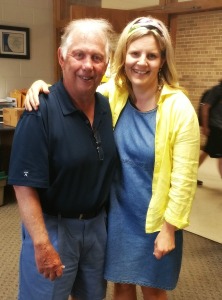
But even more manic, imagine my surprise (and manic reaction) when a few weeks ago in late May into my classroom on a seemingly ordinary day walked Mr. Bergener, my 6th grade teacher. “I read your blogpost,” he explained, with an ear-to-ear grin, "I was typing you an email, but then thought, no, I really need to go see her." 
rick b1So there he was, in my classroom, my beloved 6th grade teacher who I hadn't seen in 36 years, when he used to be a daily part of my ten-year old life. I had the fortune of being able to thank him in person for the lasting impact he had on me. We reminisced about classroom moments and referenced the challenges of education today.
And upon my invitation, last week, Mr. Bergner and his lovely wife made a guest appearance at my family 4th of July family get together, where he completed the reunion with the rest of my family, my parents and three of my siblings, each of whom he remembered in detail. He delighted in learning what we're up to, caring about us as 6th graders and as adults.
And that, dear readers, not test scores, is the mark of a great teacher.
Thank you Rick Bergner, and thank you Wisconsinites for the wherewithal to make those calls and sign those petitions. Thank you for caring for Wisconsin students.  
Therein lies my currently manic state wherein Kindness and the Public Good seem to be in the lead.  
Let’s hope it’s a trend in Wisconsin and not just a fleeting moment of summer bliss.