Monday, June 13, 2016

Fel's Regret List: my attempt to live vicariously through my students as they head off to college

Graduation-HatsThe last day of class with my AP English Seniors is always an emotional one. I've come to adore these scholars over the course of their high school careers. As I bid them farewell, I leave them with two final handouts: a reading list: Fel's Kicking and Screaming List and a list of college advice: Fel's Regret List, which is the content of my blogpost this month:
Fel's Regret List: Wisdom in Hindsight from a College Grad
  1. Foreign Language. The more, the better. My do-over would include Latin (for a solid knowledge of roots and etymology). Never again will you have an opportunity to REALLY Learn foreign languages, and doing so will vastly improve your language and vocabulary facility in deep and authentic ways.
  2. Travel. Even though you will inevitably be broke in college, never again will it be as cheap to travel, nor will you ever be able to immerse yourself in a foreign culture for a prolonged period of time as you will if you study abroad in college. Trust me on this one.
  3. Don’t work too much. During the school year, work for petty cash, but not for tuition. College debt is both the best debt you will ever accrue and the best investment you’ll ever make. Dive in head first. Don’t spend all of your time studying and working (see #8 below).
  4. Take some weird, interesting classes, making yourself a little more weird and interesting in the process---consider judo, basic drawing, African literature, art history, Japanese, fencing, music theory, ballroom dancing...you get the idea. And (this is a beautiful thing) you can audit classes, so you can simply enjoy them without the stress of credits or grades.
  5. Cavort with your profs. Use their office hours. Most are pretty brilliant and fascinating creatures who love talking with their students one-on-one. Get help thinking through a paper you’re writing, ask for clarification of a concept in class, or just ask them their views on your latest ponderance about the universe. I have ALWAYS left professors’ offices glad that I had made the effort, and I saw almost all of my prof’s during their office hours at least once.
  6. Set an artificial deadline for your papers (1-2 days before they’re actually due). If you stick to that deadline, allowing yourself a day to polish, you’ll receive a higher grade, and more importantly, your paper will be significantly more focussed and eloquent, cementing the impression that you are a good thinker and an effective communicator.
  7. Pursue a scandalous love affair with your University Library. Need I say that these palaces of wisdom are oozing with morsels of knowledge yet unknown to your noggin? I’m talking about millions of books; thousands of magazines. So rummage around; shake up your thinking: humble your ego; get lost in the stacks! Play Fel by spending a couple hours in the library on Friday afternoons perusing magazines and journals you never knew existed.
  8. Read and heed kiosks. The free-standing bulletin-board-like things with about 10,000 staples in each, located all over campus? They will alert you to the notable, the cool, the quirky---the campus goings on. Carve time out of your life to experience some of these things---never again will there be so much going on around you, and most of it’s free. This is your chance to become even more interesting, cultured, and worldly than you already are: musicians, foreign film festivals, poets, radical thinkers, foreign dignitaries, etc...they show up on college campuses. Take advantage of this phenomenon!
  9. Check out the local arts scene. Repertory theatres, symphonies, art museums, etc...Most have obscenely reduced ticket prices for students. You’ll never have a cheaper opportunity for high culture!
  10. Disco on Fridays, climb a tree and stay there for a while, drop your backpack mid-campus and do a cartwheel, travel via pogo stick, have a stare down with a stranger...you get the idea. A direct correlation between the intellectual and the irreverent makes for a happy, balanced scholar.
  11. Keep a notebook of all the things you want to do, use, or remember (and start now!): striking quotes, “to-read” book titles, irresistible words, phrases, descriptions, facts, jokes, goals, anecdotes, anything, everything. The alternative is to forget many unforgettable things and/or spend countless minutes of your life searching in vain for little scraps of paper you jotted things down on. When you add to your notebook, read what was written before, massaging the dendrites. When  you fill one notebook, start another, and keep them all (and use the Evernote App if you’d rather be paper-free).
  12. Socrates says, “Know Thyself”; Fel says, “Challenge Thyself. Take control of your intellectual destiny.  If you’re at a school or in a program that isn’t adequately challenging or beneficial, make a change!  You are at the helm of your own boat, dear scholars, steer accordingly!
  13. Lastly, and most importantly: that little voice inside you? Listen to it! Call it what you will---your conscience, your soul, your deep-down gut instinct. It’s there, and if you really listen to it, it will lead you to the right place. Though I sometimes ignored it when convenient, ultimately, I did listen, and it led me to you, oh scholarly ones (a.k.a. a fulfilling career), my husband (the soulmate thing) and other unmentionables (that Fel, so mysterious).

Sunday, May 8, 2016

A Teacher’s Reflection on Mother’s Day

Today was a bizarre day for me – my first Mother’s Day as a mother without my son around. No, he’s not studying abroad; no he doesn’t have a career halfway across the country. Lucky for me, he’s still a teenager and still a member of our household, but he’s on a class trip this week, and Mother’s Day feels more than a bit strange without him. No breakfast-in-bed, no handmade card.

I missed my breakfast-in-bed fruit plate this Mother's Day!


And my Mother’s Day malaise is doubled this year with my husband one day out of ankle surgery, non-ambulatory and sleeping most of the day.

I remember feeling this way at an earlier time in my life: mid-to-late June during my first few years of teaching. After school let out, a certain melancholy took over – life was a little too quiet, too calm, to unharried. Don’t get me wrong, I loved the feeling of not having stacks of essays, tests, and lesson plans looming, but I missed my students: their energy, their goofiness, their joie de vivre.
I can practically hear the response of some reading this (“Are you SERIOUS?! Summer means you survived! It’s the game-winning shot, the final touch down, the hole-in-one!") But yes I am serious, which I suppose, makes me one of two things: a loser ("Get a Life!”) or a person whose identity is deeply tied to teaching, not unlike motherhood to a mother.
Perhaps it’s no coincidence that Mother’s Day comes at the tail end of Teacher Appreciation Week as now that I think about it, motherhood and teaching have much in common:
Love.  Sit down with a teacher and ask them why they teach. Knowing the formidable challenges in education today, this is a fair question. If it were for money, benefits, status, or respect, we’d have left the profession years ago (and some have). The only logical reason to stay is because we love our students, not unlike the unconditional love celebrated on Mother’s Day. When everything else is stripped away, love of students and love of teaching are what remain.  
Heartache.  The flip side of love is heartache, and any educator worth his/her salt feels it. I don’t know of any teacher who hasn’t lost sleep worrying about students—their home lives, their challenges, their choices. That sick-to-your-stomach feeling you have at 3 a.m. as a mother? Imagine having 125 kids and you’ll have a sense of how difficult it is to “leave-it-at-work.”
Commitment.  No such thing as part-time parenting, right? Welcome to teaching. Students spend more of their waking hours at school than any other place, and so do teachers. We invest our lives in the lives of our students. This commitment bleeds into our nights and weekends. And the commitment of teachers who also advise and coach is exponential as they help students develop a positive future. Sound a bit like parenthood?
Identity: I’ve been asked why I haven’t become an administrator, and the answer is easy: I’m a teacher. As sure as I’m a daughter, sister, wife, and mother, I’m a teacher. And just as I couldn’t drop any of those other titles, I couldn’t simply drop my identity as a teacher. Unthinkable.  
Value: We know what happens to kids when parents check out. We know what happens to classrooms when teachers check out. Likewise, we know what happens to kids when parents and teachers and schools are fully invested them. It is an awesome responsibility and honor to play that role in students’ lives.  


Interesting that since becoming a mother, my June blues have faded – that withdrawal I felt when school let out? My summers as a mother have enough teaching in them to quell the melancholy.
And when Eliot leaves for college in 5 years, I suspect the reverse will also happen and the fact that I’m still teaching will mitigate my empty nesthood. For what teacher’s nest is ever truly empty?
Henceforth, I shall celebrate Teacher Appreciation Week and Mother’s Day together, a natural pairing.  
Being a teacher has made me a better mother, and being a mother has made me a better teacher.
And both have made me a better person and given value to my life. 
Double bonus. Lucky me.  

Monday, April 11, 2016

Are Teachers Real People? Life Inside and Outside the Classroom

The age old question persists: Are teachers real people?
I remember one morning in high school when Mr. Yach’s wife stopped in to drop off his V8 during Freshman English. I was amazed that he had a wife and that he drank V8! I was dizzy with this insider info: It felt like Teacher TMZ.  
Another oft’ repeated story in my family is when one of my sisters saw our kindergarten teacher...wait for it...wait for it...smoking a cigarette!
Teachers-are-People
She was not on school property, she was not at a school event, and it was years after we’d had her as a teacher, but none of that made the bite any less venomous. Mrs. Hintzman was smoking a cigarette! Our blood ran cold, our memories had just been sold. This was at least as bad as J. Geiles discovering the fate of his childhood girlfriend.
And so, becoming a teacher, I was well aware of the importance of reputation and the odd fascination that can surround teachers’ personal lives.  
Case in point: I am a resident of the small community in which I teach. So although I’ve lived here almost 20 years, I’ve never stepped foot into the legendary annual ETBT (East Troy Beer Tent) because...I’m a resident of the small town in which I teach.
Those types of decisions are no brainers.
The harder ones involve things that matter more - my beliefs, my opinions, my values.
In my younger years, this was not a problem. I grew up in a family that had dinner-table debates, intense ones which often included the use of dictionaries and encyclopedias and occasionally featured my dad’s fist hitting the table, spilling our glasses of milk.  We were raised to speak our minds and to back up our opinions.
High school and college provided similar opportunities. As an editorial writer for The Mustang Express and The Marquette Tribune, I became accustomed to using the written word to speak my peace and to challenge conventional thinking.
However, public education, I discovered, is a slightly more complicated arena.   
One of my first years teaching, our local library referendum was overwhelmingly defeated on the same day the US Congress allocated billions of additional funding for the war in Iraq (Part I, that is). My hot little fingers (mimicking my hot little temper) pounded out a letter to the editor singing the injustice of it all.
Version 1 was no holds bar. Then, I had my husband--Mike Felske a.k.a. My Filter--read it and help me tone it down, making my liberalness a tad less flaming. Then, and only then--or so I thought--did I send it off to the East Troy Times.
Not until one of my students, jubilantly quoting me, entered my classroom the next week (one who would regularly don a homemade T-shirt reading “Books Not Bombs!”) did I realize it was the pre-edited version of my letter that had somehow made it to the paper.  A deep crimson crawled down my face as I realized my untamed message was now community-wide.
Backlash included a few weeks of ugly gazes (some legit, others just my paranoia, I’m sure) at the grocery store and post office. Soon enough, though, things were back to normal but with a slightly more savvy me.
But back to our question: Are teachers real people? Or, less hyperbolically, as a public school teacher, to what extent can I be true to myself and my beliefs in and outside the classroom?
16468620-keep-it-real-phrase-handwritten-on-blackboard
Enter another teacher story (surprise, surprise). After high school, I learned that one of my favorite teachers held political views diametrically opposed to mine. This surprised me for two reasons: 1) I never would have guessed that she held those particular views  2) Though she taught me history for two years, those views had never surfaced in her classroom.
The lesson I gleaned from all of this was the importance of keeping one’s personal views out of the classroom. I learned so effectively from Mrs. Rice because she didn’t teach me what to think, but how to think. She never risked alienating her students by telling them her views. Teaching them to think for themselves is what was most important.
And so, it has always been my position to keep my political views out of my classroom. Yes, we talk about controversial issues in debate and persuasive writing, in our discussions of nonfiction and fiction alike, but I don’t state my opinions; rather I ask questions, I nudge, I play both pro and con. My mission is to get my students to think, to weigh, to investigate, to support.
Okay, that’s all well and good, but we still haven’t answered the question: Can teachers be authentic and “real” people, true to themselves? I am a teacher, but I am also a citizen, a voter, a human being. Just because I don't express my opinions in my classroom doesn't mean they’re not important to me. The 10 year old at my parents' dinner table still dwells within. The editorial writer in me still has a row of sharpened pencils on her desk.   
As a public school teacher and an opinionated human being, here’s my imperfect solution:
I DON’T:
  • Tell students who I’m voting for
  • Keep one shred of political affiliation on my body or in my classroom
  • Take sides on political issues in class
I DO:
  • Write a monthly blog expressing my views on educational issues
  • Put bumper stickers on my car when I feel the urge
  • Attend protests when I am so inclined
  • Speak when interviewed (as a private citizen, not as a public school teacher)
Though these do’s and don’ts delineate between my public and private spheres, they don’t come without soul searching. Not being 100% myself in the classroom means not being fully authentic while (here comes the hypocrisy) trying todownload help my students become their fully authentic selves.

Like anything that matters, it’s cloudy, imperfect, and complicated.
A year ago, my do and don’t lists were further tested when I wrote an Open Letter to Governor Walker.  What I thought was a routine blogpost on educational issues turned into a public declaration of my political views to the nation. My blogpost went viral (I'm used to a readership of about 30, not 300,000). This was, to say the least, new territory for me.
I don’t regret the letter; I’m proud of the attention it received and the conversations it engendered.

There were SO many lessons it taught me as a writer and as a teacher of writing: the power of words, the intricacies and speed of social media, the “new” layered world of the internet, social media, politics and news, the interconnected web of bloggers, vloggers, and online newsmakers. There were so many practical and ethical facets to that experience. When I stop to think about it, my mind is still reeling.
But here’s the weirdest part: All of those lessons---authentic, real-life, unscripted, powerful lessons about the written word---will never make it into my classroom.
Bringing those “lessons” into my classroom would be crossing the “don’t” line: it would be bringing my politics into my classroom; it would be taking a side; teaching the “what” instead of the “how.” It would be violating the Mrs. Rice Rule.
And so, the whole ordeal will remain The Best Lesson I Can Never Teach.
Meanwhile, both sides of me--the conscientious teacher and the opinionated citizen, though not in complete unity--will coexist imperfectly.

Tuesday, March 8, 2016

Drop Educator Effectiveness: An Exercise in Common Sense

If you lose 50 pounds, do you buy some new clothes you’ll look great in, or walk around in saggy, baggy old ones?
If you finally pay off your car, do you spend that money elsewhere, or do you keep sending in that $500 check every month?  
If your engagement is broken off, do you move on, or do you spend the rest of your life sitting in your wedding dress in front of your uneaten wedding cake, Miss Havisham style?
If you’re driving to Disney for a family vacation, do you stop when you reach Orlando, or do you keep going because there’s still gas in the tank?  
If the federal government revokes Educator Effectiveness (an ineffective, time-consuming mandate that makes teachers feel like dogs chasing their own tails) do you revoke it at the state level as well, or do you keep it in place because, well, it’s in place?
So, here’s the thing. As you may have guessed, this last hypothetical is not a hypothetical.
In December, the United States Congress reauthorized No Child Left Behind Act (now called the Every Student Succeeds Act). The re-authorization included revoking the federal mandate for the Educator Effectiveness System.  Yet, thanks to Wisconsin legislators, this highly problematic initiative remains law in the State of Wisconsin.
My question (and I believe the question of many Wisconsin educators) is: Why not buy new clothes, stop sending in extra car payments, take the wedding dress off, stop in Orlando, and why not bow out of a failing Educator Effectiveness System, which yields negligible results and diverts enormous amounts of time and resources that could be better spent in Wisconsin schools? 
Anything less is nonsense.

Tuesday, February 9, 2016

Nerve-Racking & Game-Changing: A Flipped PD Experiment

So how was your week, last week? Mine (thanks for asking) was daunting, nerve-racking, stressful, gratifying, energizing, and game-changing.
Here’s the scenario:
Imagine teaching teachers (daunting, yes?). Now imagine you are a peer of those teachers (worse). Now, imagine that you are teaching them the day before grades are due and a new semester starts (a day formerly reserved for grading and planning). Now imagine teaching them on that day and being held accountable for each teacher’s learning on that day.
stress chalk boardOkay, deep breaths.
Now, on top of all that, imagine that they are allowed to complete this training...anywhere they want---at home, at Starbucks, in a hotel room at the Kalahari, wherever they choose to be that day.
I can imagine what you're thinking right about now...perhaps a polite “no thanks” or a slightly more frank “Hell no!”
Well, that’s precisely what happened last week in my district, with yours truly at the helm (now you’re beginning to understand the dauntingnerve-rackingstressful part). We designed “PD Anywhere": a full day of Professional Development that teachers could complete, well, anywhere.
Here’s what it looked like:
  • a Google Hangout to introduce the day.
  • a self-paced technology skill checklist with hyperlinked tutorials so teachers could teach themselves technology proficiencies.
  • a “flipped” Eric Mazur’s “Peer Instruction” video (our virtual key note speaker).
  • a video of our own students engaged in “Peer Instruction.”
  • four break-out sessions instructing teachers how to use different tools (Google Classroom, Pear Deck, Socrative, and “Unplugged” tools) for “Peer Instruction.”
  • teacher work time to apply this knowledge to their own classrooms.
  • accountability pieces throughout the process.
Why did we do it? Certainly not to save time; it took us easily three times longer to prepare. Certainly not to make things easier as the probability of things going awry was exponential. We did it in the hopes of modeling good teaching. After two years of providing tech training for teachers, encouraging them to create lessons that are student-centered, flexible, and personalized, it wasn’t until this inservice that we finally felt that we truly “walked the walk,” demonstrating the practices we’d been advocating.
practice-what-you-preach1
We were able to leverage technology to personalize the day for each teacher, meeting them “where they are” (just as we strive to do with students).  And just as we know the most effective teacher is the “guide on the side,” not the “sage on stage,” we put the onus on the learners while being a call or an email away to help as needed.
We were also able to model courage. Trying out a new technique in front of a room full of teenagers can be unnerving, and more often than not in the case of new technology, things don’t go smoothly the first time around. In designing a full day of professional development where the staff did not need to report to work, where we were banking on all the online tools we were using to work correctly that day, where WIFI had to be alive and well in all the various places our staff would be located that day, we also took a sizable risk, in the hopes that our teachers will be more likely to take risks in their own practices.
How did the teachers respond? Here’s a representative sampling of their survey comments:
  • yoga teacherIn one PD day, I learned many skills that will make me a more polished teacher. It was critical that I could learn the specific skills at my own pace - technology does not come naturally to me, so this was really a useful day!

  • I'm so happy that we could breeze through stuff we already know rather than being forced to listen to it for 45 minutes during an in-person inservice. It opened up my time to be spent actually trying out the stuff I did learn. This definitely was a much more efficient, productive use of my time.
  • Thank you for the option of working at home. It felt like a real luxury! I found that I was more focused and more productive working on my own and moving at my own pace than on most inservice days. I also did more planning about how what was being presented (Mazur’s methods) can be applied to my classroom.
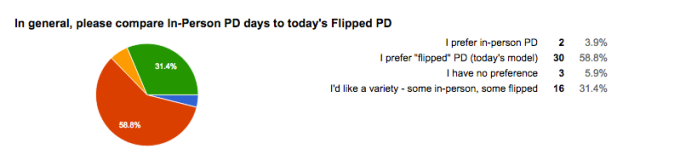
All said and done, (stats), only one didn’t turn in all three required components (was working a long time on skills list), and only 2 negative comments on the day (all others were positive).
Screen Shot 2016-02-03 at 10.01.49 PM
My take-aways that day? My professional development? My epiphanies?
  • Helping a few colleagues navigate their way through the morning, I was reminded that teachers, just like students, have different predilections, paces, and styles of learning that we must accommodate.  
  • Hitting a satisfying “lull” midday, I realized that what we had planned was working, no emails, no phone calls. I felt like the director standing in back of the theatre opening night with nothing to do but watch (smiling sigh).
  • Seeing the lesson links come in from teachers who had time to apply their learning, I realized the practicality of the day, that students would very soon be the beneficiaries of their teacher’s learning.
And so I’ll take the daunting and nerve-racking along with the gratifying and game-changing: the yin yang of teaching and of PD, reminding me to take risks, to practice what I preach, and to remember that what’s good for kids is also good for their teachers.

Monday, January 11, 2016

Lessons in a 4-inch Box

You can take the teacher out of the classroom, but you can’t take the classroom out of the teacher. It’s Christmas Vacation as I write this, and I have students-on-the-brain.
Case in point: I’m watching my son enjoy his favorite Christmas present, and it’s got me thinking about teaching again.
It’s the loop pedal’s fault. I didn’t even know what a loop pedal was until I gave Eliot’s Christmas List its due attention. And now, not only do I think it’s the best present we could have bought him, but I think it’s a master teacher.    
loop
Huh? How can this little contraption (“THIS was $99?” I exclaimed, unimpressed, upon its arrival) be so miraculous?  What, even, is it? The loop pedal is a gadget that allows Eliot to make short recordings with his guitar and then play over those recordings, creating loops or layers of music. And because it’s a pedal, the recording part is “hands-free,” making the process of playing, recording, listening, re-recording and layering seamless.
But is this teacher sacrilege? How can I give an inanimate object teaching kudos, especially since singing the praises of Eliot’s real-life guitar teacher, Craig Friemoth? It was just two Christmases ago, when I wrote about Eliot’s gift to me: he had taken my favorite song at the time and created and played an extended, remixed version of it for me on his guitar. I called it “the best present I’d ever received.” It affected me deeply as a mother and as a teacher as I witnessed Eliot’s growth as a musician and I pondered how to elicit such creativity and engagement in my classroom.
The continuing influence of Craig’s teaching on Eliot’s love of music and growth as a musician can’t be overstated. How, then, can I now bow down to the almighty loop pedal as the ultimate teacher?
Here’s how. This is what he’s doing:
dsfasdfads
Eliot & loop pedal at play
  • He’s examining the process of music making and the parts of a song.
  • He’s perfecting his craft. In any process, there are “cheats” and shortcuts. But a loop recording exposes and amplifies the smallest error. So now there’s an organic motivation for perfection which is fueling extra practice.
  • His creativity has exploded. His love of playing classic rock riffs continues, but now it’s mixed with loads of experimentation.
  • His aha moments are many.  After he plays a loop, adds another and another, I hear all sorts of “ah,” “no” “okay...”wait”... as he’s discovering the interplay of these sounds and then tweaking them for various effects.
  • He’s learning the thickness of music. By that I mean he’s experiencing the richness of music as the sum of its parts by deconstructing it and then reconstructing it. It’s like playing in a band while being all the band members.
  • Perhaps most importantly, he’s getting that all-important feedback loop that we know is critical to learning. The loop pedal doesn’t lie. It plays back what it hears, making him painfully or ecstatically (whichever the case may be) aware of his abilities, providing feedback and motivation for correction.
Make no mistake: without the guidance of Craig, Eliot wouldn't be ready for any of this. A master teacher enables a student to become his own teacher and prepares him for other “teachers” (human and non-human varieties) he’ll meet along the way.  
And so, I end with three pats on the back and a question:
First the back pats:
  1. One to Mike and I for heeding the Christmas list.
  2. One to Eliot for creating it.
  3. One to Craig for making him ready for it.  
And now, for the perpetual question:
How can we as educators do this? How can we provide for our students the foundation for life-long learning, the readiness to recognize and leverage all the potential teachers they will meet in life?  

Sunday, December 6, 2015

Dear Cassidy: A Case for Senior Year

Dear Cassidy*


I must admit, when you told me a few weeks back that you want to graduate a year early to get a jump start on college, an immediate and somewhat surprising sadness washed over me. I tried not to show it, but I think you may have noticed.

I’m also pretty sure that when you asked me for a letter of recommendation this isn’t what you had in mind. Fear not, I wrote two letters: one to the Office of Admissions and another (this one) to you.


In the official letter, I praised your academic achievements, your talents as a thespian, musician and athlete. I also recommended your admission into college, since that was your wish.


And while I stand by every laudatory word I wrote in that letter, it was not my complete recommendation. An unadulterated version would include my recommendation that you stay in high school next year, that you don’t live your life in fast forward, that you experience (dare I suggest treasure) your senior year.


Why? Because the thing about senior year is that there’s only one of them.


My fear is that if you don’t experience senior year, you’ll miss out on one of life’s great experiences, like someone who’s never slurped a shave ice at the beach, never made a snow angel, never read a Harry Potter book, and has to go through life wondering what all the nostalgia is about.  


There’s so much in senior year that’s celebratory, cumulative, and icing-on-the-cake-ish. It’s a chance to celebrate you and the culmination of 13 years from the moment you walked into kindergarten with your velcro shoes and Little Mermaid backpack when telling time and writing your name were your biggest challenges to the moment you walk out of high school in yoga pants and leg warmers (yes, they’re back) able to quote Shakespeare, explain the double helix, and play Take Five on the saxophone. A journey worth completing, a rite of passage worth celebrating.  


Pondering this, I recently recruited the wisdom of Facebook friends, asking their thoughts on senior year and early graduation. Here’s a sampling of their responses:


from recent HS grads:


  • I feel like if I had needed to go to college after junior year I probably could have done it but senior year gave me time to really be ready to move on. I think it would have been a shock to move to a huge campus setting a year earlier than I did.
  • Senior year was my favorite year of high school! I got to take classes that I really enjoyed and these classes gave me skills that I'm currently using in college. Besides academics, I felt that my extra curriculars, like theatre and choir, were the most rewarding during my senior year. I'm incredibly thankful I had all of that time to spend with my favorite people.
  • Being able to graduate and experience those "lasts" of senior year with the people and friends I grew up with from grade school is important, I think. I've always believed that with anything in life the journey is just as important as the destination (as cliche as that might sound), especially when you’re young.


from Adults (friends and colleagues):

  • I think it's indicative of a problem in our culture, no one lives in the moment, they are constantly looking forward to the next thing. No one enjoys the here and now.
  • I really became comfortable in my own skin during my senior year. I stopped caring so much about what other people thought of me. I grew out of that teenage funk and sprouted grownup wings.
  • Senior year is when it all somehow came together for me. Without realizing it, I become a leader and became responsible for myself. And by the end of senior year, I was finally ready to leave it, the perfect confluence of events.
  • Frontal brain development! No matter how mature or intelligent someone seems, that frontal lobe is just not developed. Only time can do that.
  • Hurry up and finish high school so you can hurry up and get through college so you can hurry up and work for the rest of your life?! It's about the journey--not about racing to the finish line. And college is a whole lot more expensive - financial aid and scholarships just aren’t there for early grads.
  • One year at that time in your life is HUGE. I wasn’t ready for the freedom and risks and temptations at college. I probably thought I was, but I wasn’t.


I must also note one of my FB friends who veered from the “pro senior year” camp, wisely pointing out that “not every student has a perfect home life...and moving on is in their best interest.” She also pointed out my central contradiction: that if I didn’t think early graduation was a good idea, perhaps I should consider not writing you a letter of recommendation.  


As your teacher, though, I believe it’s my job to teach you, support you, and prepare you for your next step, whatever that may be. It’s my job to write a letter of recommendation that honestly represents you and conveys your abilities. It’s your job to decide what those next steps are.


So now, two letters are complete: one about you as a student, someone who can, if she chooses, face the rigors of college one year early; and one to you as a person, someone I care about, someone whose ultimate decision I will wholly respect.


Best of luck to you, Cassidy.*


With fondness,
Mrs. Felske


*Name has been changed to protect the scholarly.